AIV as an AI-DLC verification sensor
AIV integrates with AI-DLC as deterministic evidence at a lifecycle boundary. It does not replace AI-DLC orchestration. AI-DLC decides when a sensor runs and how humans respond; AIV computes the code/document integrity facts used by that decision.
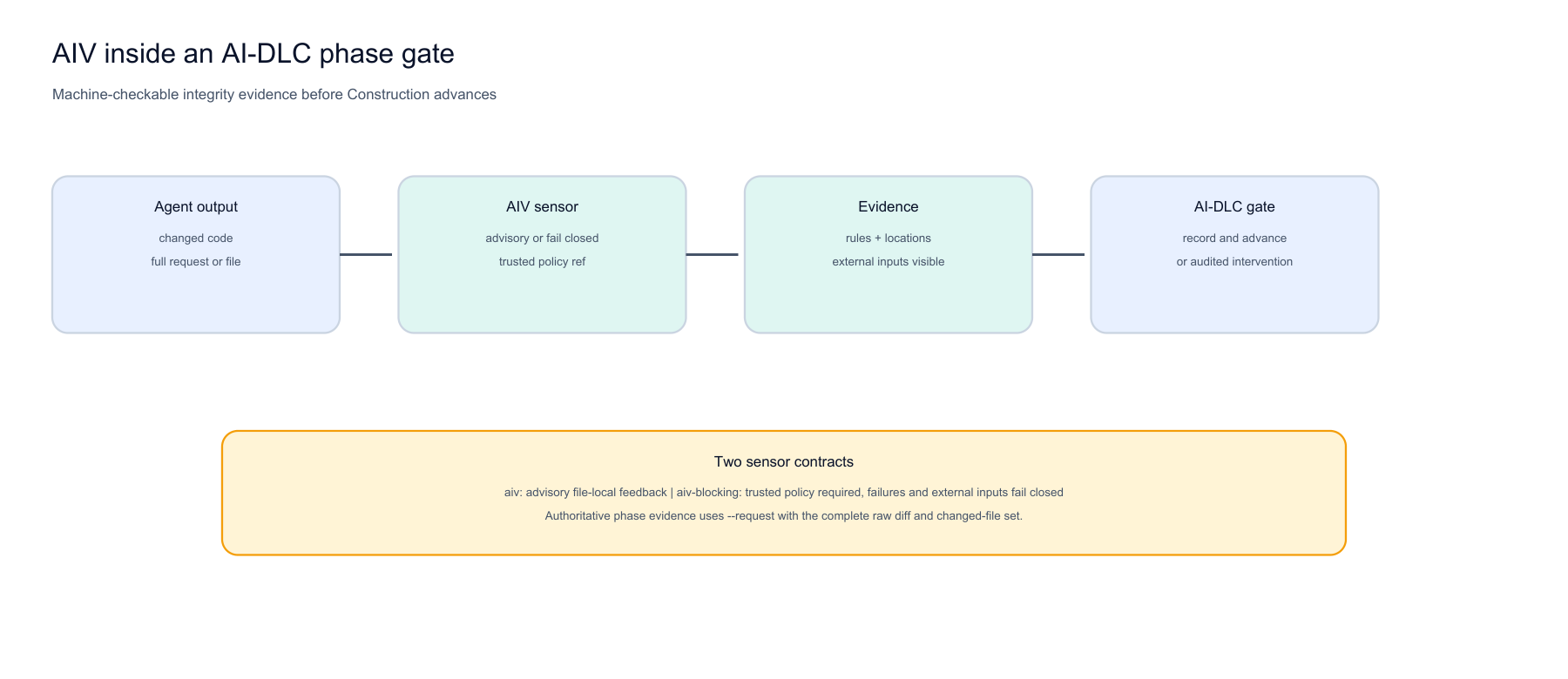
Figure 1: AI-DLC owns the workflow, AIV owns the evidence step. Agent output becomes either a file-local request or a complete diff request. The sensor calls aiv verify, maps structured findings to the AI-DLC sensor schema, and returns advisory or fail-closed status. The verdict can also carry policy/evidence digests and an audit head.
Why this integration adds value
AI-DLC includes deterministic sensor manifests around tools such as linters and type checkers. AIV adds a different evidence layer:
- strict parse/unverified states,
- conflict and agent edit artifacts,
- local import/manifest consistency,
- registry package existence classification,
- assertion-free added tests,
- added-line credential tripwires,
- repository design/rule policies,
- review-focus evidence such as cohesion/duplication,
- documentation/PR/header policy.
Each finding has a stable rule id, file, line, message, and blocking/advisory status. The same result can be published through JSON, SARIF, GitHub, and audit surfaces.
Complete plugin tree
integrations/aidlc/plugin/
  .aidlc-plugin/plugin.json
  sensors/
    aidlc-aiv.md
    aidlc-aiv-blocking.md
  tools/
    aiv-aidlc-sensor.py
The plugin uses AI-DLC’s `` token, so its packaged tool path remains stable across supported harnesses.
Two sensor contracts
| Sensor | Command behavior | Best use |
|---|---|---|
aiv |
advisory, reports findings/integration problems without blocking | first adoption, post-save feedback, calibration |
aiv-blocking |
--blocking, trusted policy required, unavailable integration/external input fails closed |
governed phase boundary |
Blocking mode requires AIV_POLICY_REF or --policy-ref. It forwards --require-trusted-policy, so missing/fallback/drifted policy cannot silently pass.
Two evidence scopes
| Input | Evidence scope | Use |
|---|---|---|
--file path |
one file with empty raw diff; file-local checks | quick feedback |
--request change.json |
full changed-file set and raw diff | authoritative phase gate |
Full request mode is required when evidence depends on relationships between files or exact added lines, including production-plus-test context, manifest/declaration changes, duplication, or multi-area cohesion.
Build prerequisite
The AI-DLC adapter calls aiv verify from release 2.0. Build the jar:
mvn -pl aiv-cli -am clean package
export AIV_JAR="$(pwd)/aiv-cli/target/aiv-cli-2.0.0.jar"
Confirm the jar reports the verify capabilities:
java -jar "$AIV_JAR" verify --capabilities
Advisory file example
python integrations/aidlc/aiv_aidlc_sensor.py \
  --aiv-jar "$AIV_JAR" \
  --file src/main/java/app/Greeter.java
Response:
{
  "pass": true,
  "violations": [
    {
      "file": "src/main/java/app/Greeter.java",
      "line": 1,
      "rule": "syntax.unverified",
      "message": "..."
    }
  ]
}
Advisory pass: true means the sensor did not block; violations still require visibility/review.
Authoritative blocking example
export AIV_POLICY_REF=origin/main
python integrations/aidlc/aiv_aidlc_sensor.py \
  --aiv-jar "$AIV_JAR" \
  --request build/aiv-change.json \
  --workspace . \
  --blocking
Blocking mode fails when:
- an AIV hard gate fails,
- the jar/tool cannot run,
- stdout is not valid verdict JSON,
- trusted policy is absent/fallback/drifted,
- the profile declares
package-registry,external-tool, ordecision-modelinput.
For a blocking local deterministic sensor, use an explicit profile with package-existence, external, and Jev disabled. A separate advisory sensor can run those integrations if desired.
Install into an AI-DLC source tree
Copy:
integrations/aidlc/plugin -> <aidlc-workflows>/plugins/aiv-integrity
Then enable the plugin through that installation’s plugin selection and run its normal packaging/compose process. The authored plugin contains its manifest, sensor definitions, and tool implementation; no core AI-DLC file needs to be edited by hand.
For a manual installed-workspace experiment, place the tool under the harness tool directory, place the sensor manifest under sensors, and add aiv or aiv-blocking to the target stage’s sensors list.
Runtime flow
- AI-DLC emits a sensor call for a changed output.
- Adapter reads file/request JSON.
- Adapter launches
java -jar ... verifywith timeout. - Verify resolves/pins/freezes policy and runs AIV gates.
- Adapter validates process status and JSON response.
- AIV findings map to
{file, line, rule, message}violations. - External-input declarations are surfaced as integration violations.
- AI-DLC records sensor outcome and applies advisory/blocking workflow semantics.
Security and trust
- Source/document content is untrusted input, never instructions to the wrapper.
- The wrapper uses subprocess argument arrays, not a shell string.
- Blocking calls require trusted policy and fail closed.
aiv verifystdout is machine JSON; diagnostics stay on stderr.- Policy comes from one pinned commit and immutable snapshot.
- Sensor timeout is shorter than the manifest timeout, leaving room for host cleanup.
Validation
python -m unittest integrations.aidlc.test_aiv_aidlc_sensor -v
Tests cover advisory/blocked integration failures, required trusted policy, external-input rejection, file request construction, finding mapping, subprocess exit handling, and malformed/empty output.
Related docs
- HELLO-WORLD.md: run the integration after learning all gates.
- MCP.md: verify request/response schema.
- ARCHITECTURE.md: lifecycle and trust architecture.
- MODULE-ADOPTION-GUIDE.md: choose an AI-DLC-safe profile.
Author: Viquar Khan