AIV Hello World: learn every gate end to end
This tutorial builds the current source version of AIV, creates a small multi-language lab repository, produces a clean verdict, and then exercises every gate one by one. It finishes with strict policy, JSON/SARIF, aiv verify, the audit chain, evidence reporting, GitHub Actions, and AI-DLC.
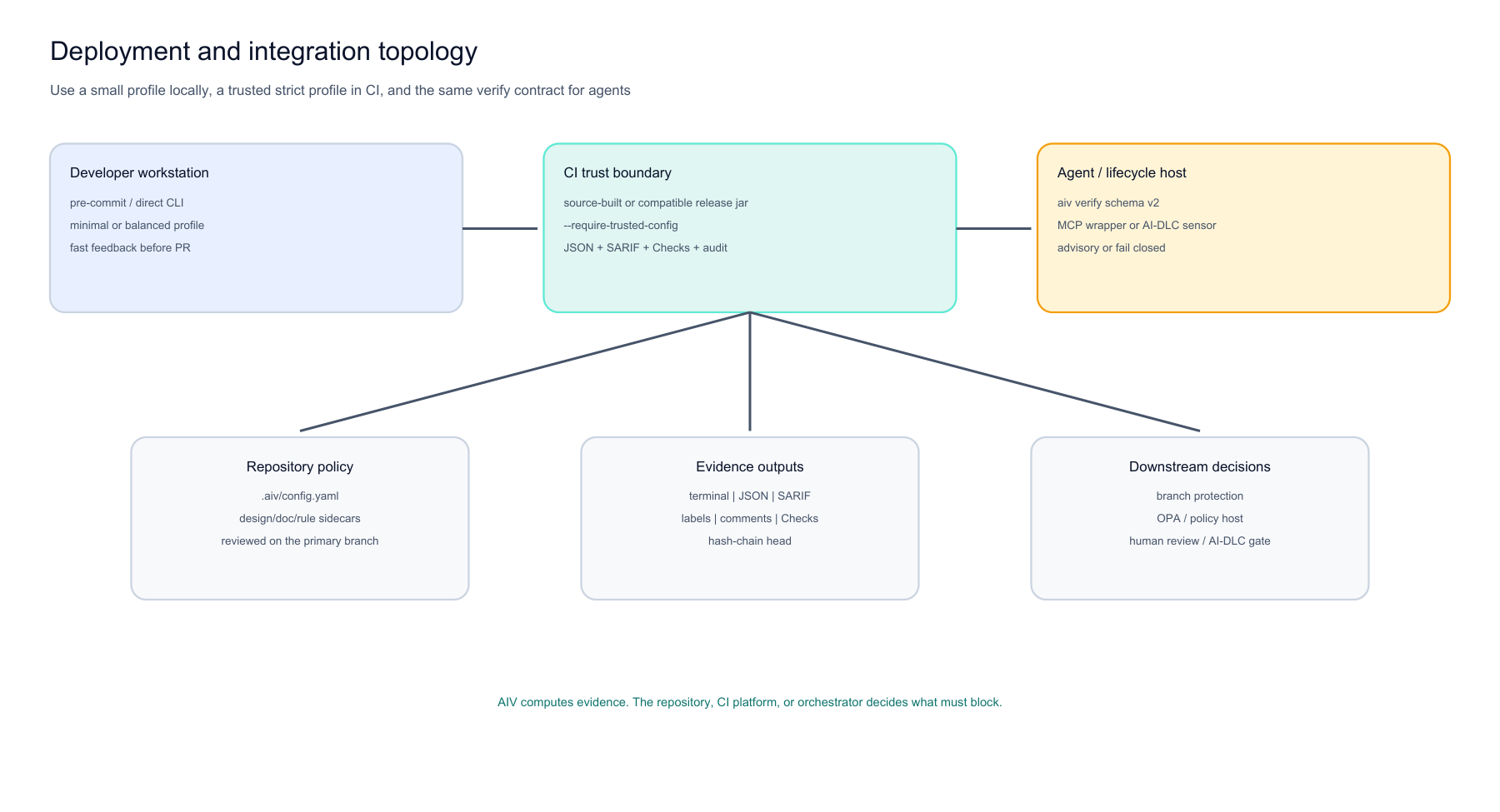
Figure 1: The lab follows the same deployment path as a real repository. You run a small local profile while learning, then move the same jar and policy into strict CI. Agent and lifecycle integrations use the same aiv verify engine rather than a separate implementation.
1. Prerequisites
- JDK 17 or newer.
- Maven 3.9 or newer.
- Git.
- Python 3 for Python syntax and the AI-DLC wrapper.
- Node and Go only if you want to exercise those external syntax validators.
This tutorial builds release 2.0 from source so the lab uses aiv verify, the policy snapshot, and the hardened Action.
2. Build the current AIV jar
git clone https://github.com/vaquarkhan/aiv-integrity-gate.git aiv-source
cd aiv-source
mvn clean verify
export AIV_SOURCE="$(pwd)"
export AIV_JAR="$AIV_SOURCE/aiv-cli/target/aiv-cli-2.0.0.jar"
java -jar "$AIV_JAR" --version
cd ..
On Windows PowerShell:
git clone https://github.com/vaquarkhan/aiv-integrity-gate.git aiv-source
& "C:\tools\apache-maven-3.9.11\bin\mvn.cmd" -f aiv-source\pom.xml clean verify
$env:AIV_SOURCE = (Resolve-Path aiv-source).Path
$env:AIV_JAR = Join-Path $env:AIV_SOURCE "aiv-cli\target\aiv-cli-2.0.0.jar"
java -jar $env:AIV_JAR --version
Expected: aiv-cli 2.0.
3. Create the lab repository
mkdir hello-aiv
cd hello-aiv
git init -q
git config user.name "AIV Learner"
git config user.email "learner@example.com"
mkdir -p src/main/java/app src/test/java/app docs .aiv/rules
Create pom.xml:
<project xmlns="http://maven.apache.org/POM/4.0.0">
  <modelVersion>4.0.0</modelVersion>
  <groupId>example</groupId>
  <artifactId>hello-aiv</artifactId>
  <version>1.0.0</version>
  <dependencies>
    <dependency>
      <groupId>org.junit.jupiter</groupId>
      <artifactId>junit-jupiter</artifactId>
      <version>5.10.2</version>
      <scope>test</scope>
    </dependency>
  </dependencies>
</project>
Create src/main/java/app/Greeter.java:
package app;

public class Greeter {
    public String greet(String name) {
        return "Hello, " + name;
    }
}
Create src/test/java/app/GreeterTest.java:
package app;

import org.junit.jupiter.api.Test;
import static org.junit.jupiter.api.Assertions.assertEquals;

class GreeterTest {
    @Test
    void greets() {
        assertEquals("Hello, Ada", new Greeter().greet("Ada"));
    }
}
Create README.md:
# Hello AIV

Build with `mvn verify`.

See [developer notes](docs/developer.md).
Create docs/developer.md:
# Developer notes

The greeting implementation lives in `src/main/java/app/Greeter.java`.
4. Install an explicit balanced policy
Create .aiv/config.yaml. Every gate is named explicitly so no omitted gate inherits an unexpected default:
schema_version: 1
fail_fast: false
exclude_paths: [target/**, build/**]
gates:
  - { id: syntax, enabled: true }
  - { id: invariant, enabled: true }
  - { id: dependency, enabled: true }
  - { id: package-existence, enabled: false }
  - { id: test-adequacy, enabled: true }
  - { id: security, enabled: true }
  - id: design
    enabled: true
    config: { rules_path: .aiv/design-rules.yaml }
  - { id: density, enabled: true, severity: warn }
  - { id: cohesion, enabled: true, severity: warn }
  - { id: duplication, enabled: true, severity: warn }
  - { id: doc-integrity, enabled: false }
  - { id: pr-metadata, enabled: false }
  - { id: license-header, enabled: false }
  - { id: external, enabled: false }
  - { id: rules, enabled: false }
  - { id: jev, enabled: false }
Create .aiv/design-rules.yaml:
constraints:
  - id: no-process-exit
    keywords: [java]
    forbidden_calls: [System.exit]
Commit the trusted baseline:
git add .
git commit -m "Create clean AIV lab"
git branch -M main
5. Run the clean baseline
java -jar "$AIV_JAR" --workspace . --diff HEAD --head HEAD
Expected: Overall: PASS. Density/cohesion/duplication may report advisory information depending on the changed set, but they do not make the overall result fail in this policy.
6. The repeatable gate-lab pattern
For each gate:
git checkout -B gate-lab main
# make the described change
git add .
git commit -m "Exercise <gate>"
java -jar "$AIV_JAR" --workspace . --diff main --head HEAD \
  --output-json aiv-report.json --output-sarif aiv-results.sarif
git checkout main
Use java -jar "$AIV_JAR" explain <gate-id> for offline rule help. The following sections show the smallest meaningful change for every gate.
7. Gate 1: syntax
Problem solved: a file that cannot be parsed should not consume a full CI cycle.
cat > broken.json <<'EOF'
{foo: bar}
EOF
Expected: hard syntax.parse. AIV uses strict RFC 8259 JSON, so YAML-style unquoted keys do not pass as JSON.
Tool-backed files can return syntax.unverified when the parser is unavailable. Set strict_toolchains: true under the syntax gate to make unverified syntax blocking.
8. Gate 2: invariant
Problem solved: conflict markers, placeholders, and agent edit instructions should not become source.
// ... existing code unchanged ...
public String greet(String name) {
    return "Hello, " + name;
}
Expected: hard invariant.ai-edit-artifact. Other examples include merge markers, configured TBD/FIXME placeholders, assistant chatter, provenance text pasted into source, and explicit tautology tests.
9. Gate 3: dependency
Problem solved: an import is present but no local project evidence declares it.
import com.fasterxml.jackson.databind.ObjectMapper;
The lab POM has no Jackson dependency. Expected: hard dependency.unresolved-import. Add the real dependency to fix it, or add a reviewed internal root to allow for private/generated code.
10. Gate 4: package-existence
Problem solved: a newly declared package name may be hallucinated or misspelled.
Enable it in .aiv/config.yaml on the trusted branch, then add:
# requirements.txt
ghost-tensor-utils==1.0
Expected with registry access: hard unknown-package finding after a definitive not-found response. Timeout, 5xx, or offline is reported as unverified; strict: true makes unverified blocking.
This gate uses an external registry. aiv verify reports package-registry in external_inputs.
11. Gate 5: test-adequacy
Problem solved: a generated test can execute code without checking a result.
@Test
void greets() {
    new Greeter().greet("Ada");
}
Expected: hard test-adequacy.assertion-free-test. Restore assertEquals to fix it.
A production change without a changed or conventionally named test produces advisory test-adequacy.missing-tests. Assertion presence is lexical evidence, not proof that the assertion is meaningful; execute tests/mutation analysis separately.
12. Gate 6: security
Problem solved: recognizable credential material appears on an added line.
String accessKey = "AKIAABCDEFGHIJKLMNOP";
Expected: hard security.aws-key. Other rules cover several provider token formats, private-key headers, assigned secrets, and keyword-bound high-entropy values. Use narrow allow_patterns for known fixtures and a full secret scanner through external for repository/history coverage.
13. Gate 7: design
Problem solved: a change violates a repository-owned architecture constraint.
public void shutdown() {
    System.exit(0);
}
Expected: hard design finding for no-process-exit. The rule comes from the immutable .aiv/design-rules.yaml snapshot, not the branch copy.
14. Gate 8: rules
Problem solved: teams need project/framework checks without creating one Java module per framework.
Create .aiv/rules/team.yaml on the trusted branch:
rules:
  - id: no-empty-handler
    kind: hollow-function
    paths: ["**/*.java"]
    function: "handle\\w*"
    message: "{value} is an empty handler"
Enable the gate:
- id: rules
  enabled: true
  config:
    rules_files: [".aiv/rules/*.yaml"]
Then add an empty handleRequest() method. Expected: rules.no-empty-handler. Rule kinds include pattern, call, and hollow-function. Classpath packs such as airflow are optional examples.
15. Gate 9: density
Problem solved: unusually thin or repetitive structure deserves focused review.
public class EmptyService {
    private String a;
    private String b;
    private String c;
}
Expected: advisory density.ldr or entropy signal under configured thresholds. Keep density advisory because low density can be legitimate in models/configuration classes.
16. Gate 10: cohesion
Problem solved: one change touches many unrelated repository areas.
Add changed files under four top-level/depth-two areas, such as:
api/orders/A.java
ui/profile/B.java
storage/cache/C.java
ops/deploy/D.java
Expected: advisory cohesion finding when the configured area/file threshold is exceeded. Use it as a reviewer-routing signal, not a semantic correctness claim.
17. Gate 11: duplication
Problem solved: an added code block copies existing repository logic.
Create an existing helper with six or more significant lines, commit it to main, then paste the same normalized block into a new changed file. Expected: advisory duplication finding naming the existing file and line.
This is an exact normalized-window signal, not a fuzzy clone detector. It is intentionally advisory.
18. Gate 12: external
Problem solved: teams already trust tools such as ruff, Semgrep, gitleaks, Checkstyle, or another SARIF producer and need one evidence receipt.
Example Python/ruff configuration:
- id: external
  enabled: true
  severity: warn
  config:
    tools:
      - id: ruff
        command: ["ruff", "check", "--output-format", "sarif", "--exit-zero", "{files}"]
        sarif: stdout
        file_extensions: [.py]
        min_level: warning
        on_missing: skip
A ruff finding becomes external.ruff.<rule>. Set on_missing: fail for a required CI tool. Processes are bounded and killed on timeout.
19. Gate 13: doc-integrity
Problem solved: documentation links to missing files, fabricated paths, incomplete commands, or violates project doc rules.
Enable the gate and create .aiv/doc-rules.yaml:
doc_constraints:
  - id: build-command
    trigger_keywords: ["build"]
    required_mentions: ["mvn verify"]
    scope: [README.md]
Change README to link to docs/missing.md. Expected: doc-integrity.markdown-link or file-existence finding. Documentation targets are checked in the source workspace; doc policy is read from the frozen policy workspace.
20. Gate 14: pr-metadata
Problem solved: a pull request arrives without enough context for review.
Enable it:
- id: pr-metadata
  enabled: true
  config:
    min_title_words: 3
    require_disclosure: false
Run locally with simulated PR metadata:
AIV_PR_TITLE="Fix" AIV_PR_BODY="Fix" \
java -jar "$AIV_JAR" --workspace . --diff main --head HEAD
Expected: title/body findings. The GitHub Action supplies the real event values. The optional disclosure check tests presence only and never infers authorship.
21. Gate 15: license-header
Problem solved: a newly added source file lacks an approved project header.
- id: license-header
  enabled: true
  config:
    header_markers:
      - "SPDX-License-Identifier: Apache-2.0"
Add a source file without the marker. Expected: hard missing-header finding. The gate checks newly added files; whole-tree license analysis remains a separate tool.
22. Gate 16: jev
Problem solved: some calibrated review questions require judgement rather than deterministic parsing.
- id: jev
  enabled: true
  severity: warn
  config:
    base_url: http://localhost:11434
    report_at: 0.75
    checks:
      - id: scope-match
        question: "Does the change exceed the stated scope?"
Jev is always advisory and is declared as decision-model in external_inputs. Missing credentials, service errors, or missing answers become visible skip/no-answer states. It never changes a passing deterministic verdict into a block.
23. Inspect JSON and SARIF
java -jar "$AIV_JAR" --workspace . --diff main --head HEAD \
  --output-json aiv-report.json \
  --output-sarif aiv-results.sarif
JSON preserves every gate, blocks_ci, notices, and structured findings. SARIF uses error for blockers, warning for advisory failures, and note for pass-with-unverified evidence.
24. Prove the policy cannot change itself
On main, keep a blocking security/design policy. On a feature branch, disable it and add a matching defect:
java -jar "$AIV_JAR" --workspace . --diff main --head HEAD --require-trusted-config
Expected: strict policy-tree drift refusal. AIV pins main once to a commit OID, compares the complete .aiv tree including ignored files, rejects symlinks, materializes policy from Git blobs, and makes all policy-bearing gates consume that frozen snapshot.
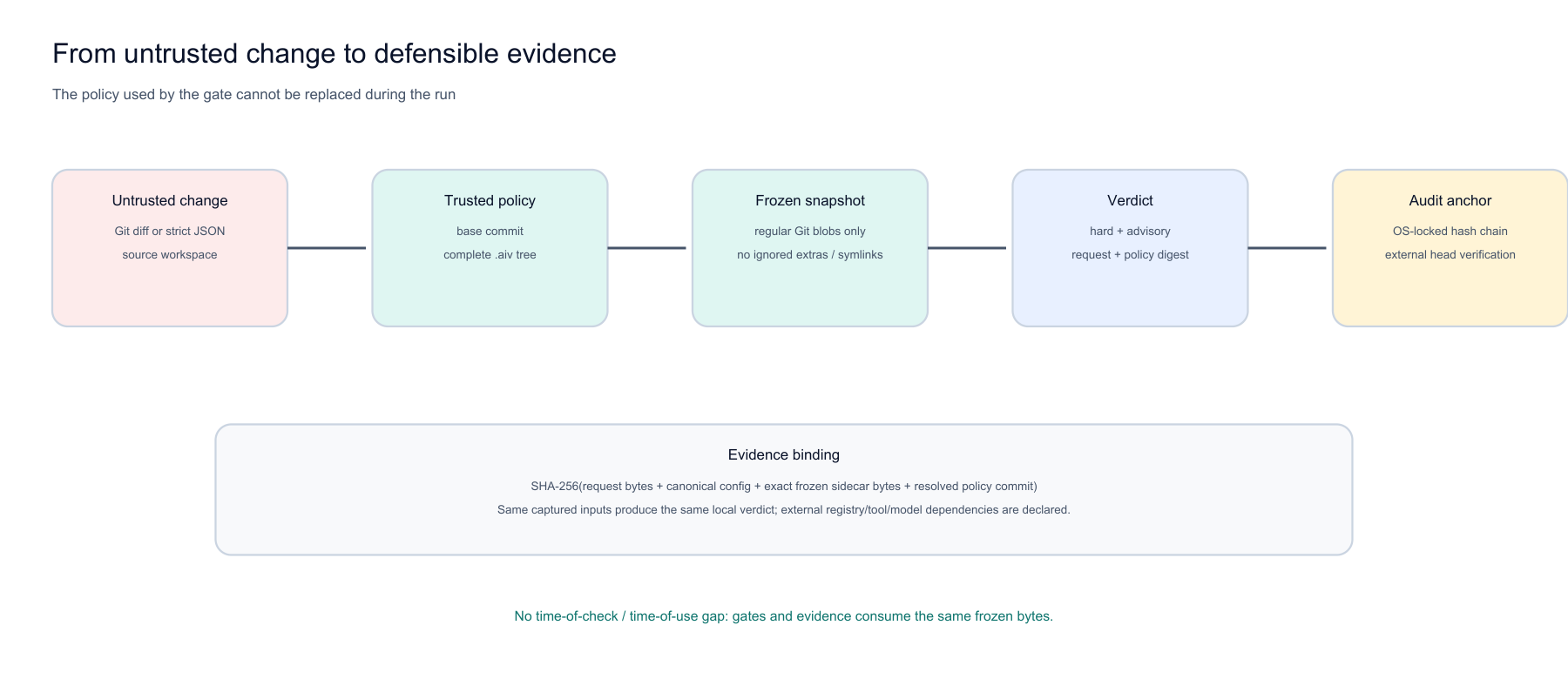
Figure 2: The artifact and the yardstick remain separate. The change is untrusted. The policy comes from one pinned commit and is frozen before gate execution. The verdict and audit name the same policy commit.
25. Call aiv verify
Create change.json:
{
  "artifact": {
    "baseRef": "memory",
    "headRef": "proposed",
    "rawDiff": "",
    "files": [
      {"path":"src/main/java/app/Greeter.java","changeType":"MODIFIED","content":"package app; public class Greeter {}"}
    ]
  },
  "policyRef": "main",
  "context": {"workspace":"."}
}
Run:
java -jar "$AIV_JAR" verify --request change.json --workspace . \
  --policy-ref main --require-trusted-policy --audit-log .aiv/audit.log
The schema-v2 response includes verdict, findings, exact policy commit, policy digest, evidence digest, declared external inputs, and audit head. Full contract: MCP.md.
26. Verify and report the audit chain
java -jar "$AIV_JAR" audit verify .aiv/audit.log
java -jar "$AIV_JAR" report --audit-log .aiv/audit.log --out aiv-evidence.html
For independent tamper evidence, store the returned chain head outside the log and later pass --expect-head <hash>.
27. GitHub Action with the source-built jar
The hardened Action requires a compatible jar. Until the next release is published, build the jar in the workflow and pass cli-jar-path:
name: AIV
on: [pull_request]
permissions:
  contents: read
  checks: write
  pull-requests: write
jobs:
  aiv:
    runs-on: ubuntu-latest
    steps:
      - uses: actions/checkout@34e114876b0b11c390a56381ad16ebd13914f8d5
        with: { fetch-depth: 0 }
      - uses: actions/setup-java@c1e323688fd81a25caa38c78aa6df2d33d3e20d9
        with: { distribution: temurin, java-version: 17 }
      - run: mvn -B -ntp -DskipTests -Djacoco.skip=true -pl aiv-cli -am package
      - uses: vaquarkhan/aiv-integrity-gate@main
        with:
          base-ref: origin/$
          cli-jar-path: aiv-cli/target/aiv-cli-2.0.0.jar
          publish-github-checks: "true"
For a consumer repository, use a pinned compatible release jar URL/path rather than cloning mutable source in every run.
28. AI-DLC sensor
Advisory file-local feedback:
python "$AIV_SOURCE/integrations/aidlc/aiv_aidlc_sensor.py" \
  --aiv-jar "$AIV_JAR" --file src/main/java/app/Greeter.java
Authoritative phase evidence uses a full request:
python "$AIV_SOURCE/integrations/aidlc/aiv_aidlc_sensor.py" \
  --aiv-jar "$AIV_JAR" --request change.json --workspace . \
  --policy-ref main --blocking
The complete plugin lives under integrations/aidlc/plugin/. See AIDLC.md.
29. Choose what to enable
Do not enable everything just because it exists. Start with the problem you need to solve:
- smallest local filter:
minimal, - balanced Java repository:
java-ci, - broad generated-change integrity:
agent-paste-strict, - framework pack example:
airflow, - community/advisory example:
asf, - custom explicit profile: recommended for production.
See MODULE-ADOPTION-GUIDE.md for mandatory modules, optional gates, external prerequisites, and exact profile matrices.
30. Clean up the lab
cd ..
rm -rf hello-aiv
Keep the source checkout if you are developing AIV. Run mvn clean inside it to remove build artifacts.
Author: Viquar Khan