A quantitative, governed fitness function for microservice boundary granularity. It fuses runtime efficiency, evolutionary independence, and team cognitive load into one bounded, diagnostic score whose weakest component names the fix.
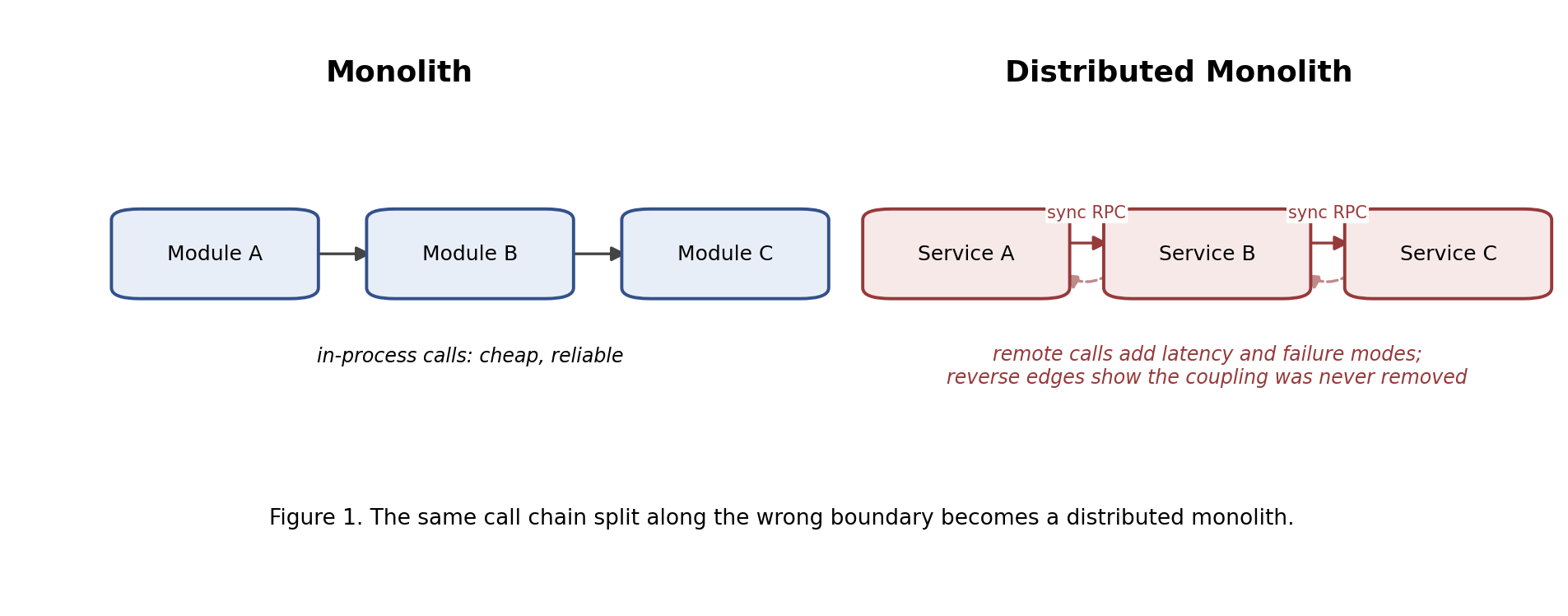
Splitting a system to reduce complexity often increases it: a boundary drawn in the wrong place turns an in-process call into a network call without removing the coupling that made the call necessary. You pay the full cost of distribution and get none of the benefit. That is a distributed monolith, and it usually looks fine on any single metric.
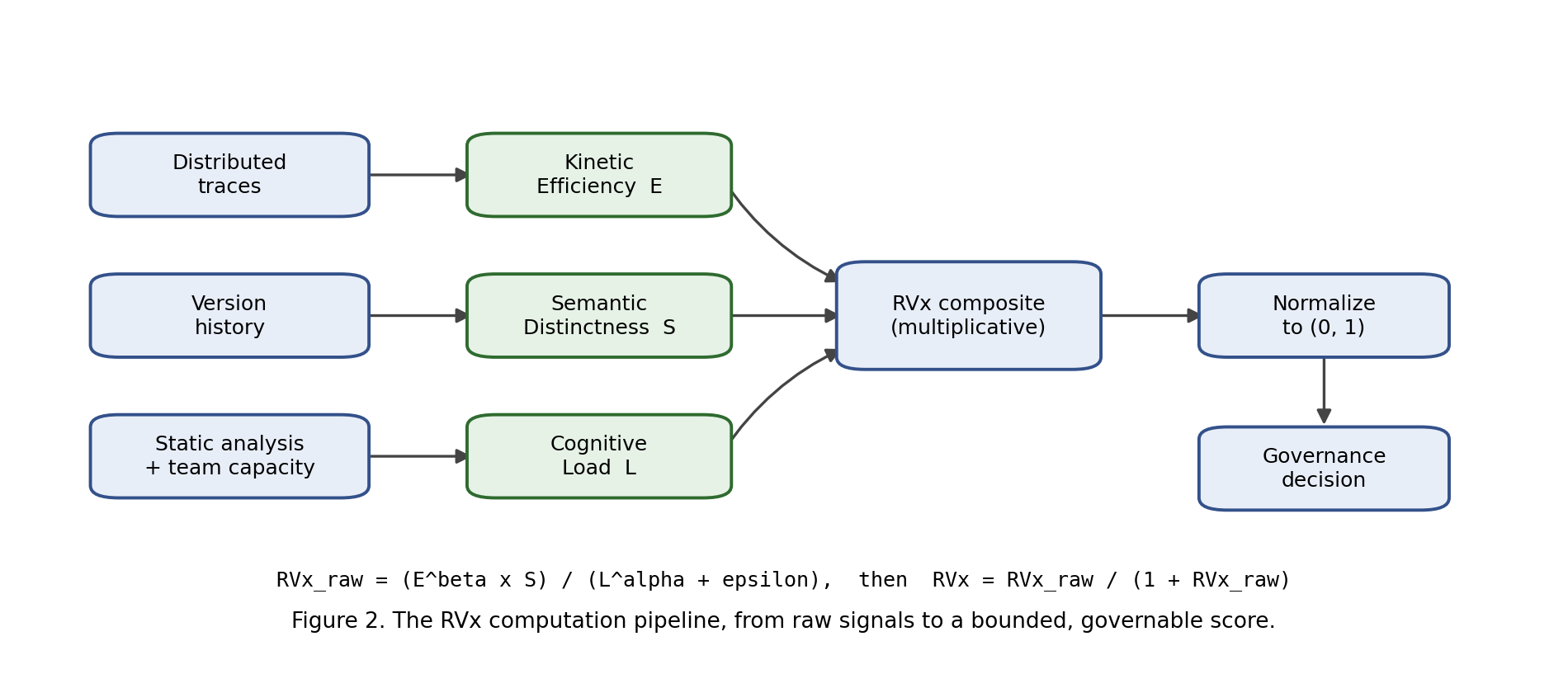
No single layer sees a distributed monolith. RVx fuses three signals that live in three different data planes, at the unit of one boundary, so the failure that hides from each one alone becomes visible.
From distributed traces: useful work divided by total transaction time. Low E means the boundary is chatty and network-bound.
From version-control co-change: 1 means the two sides evolve independently; 0 means they always change together.
Static complexity normalized against team capacity, Conway's Law made measurable. Can the owning team actually hold it?
Interpreted against three bands:
below 0.4 - distributed monolith
0.4-0.7 - at risk
above 0.7 - optimal
(illustrative defaults, calibrated per domain). A low score's weakest component names the remedy.
Built for people who know basic microservices. Each tab teaches in plain words, tells you what to watch, then runs the simulation with a live caption so the idea sticks.
A small, coherent family of named ideas for governing microservice granularity. The borrowed primitives (coupling, cohesion, Conway's Law, sagas) are credited in the paper; what is new is the synthesis.
A boundary is only as valuable as its weakest dimension. Distribution multiplies value when a boundary is efficient, independent, and ownable at once, and multiplies cost wherever any one fails.
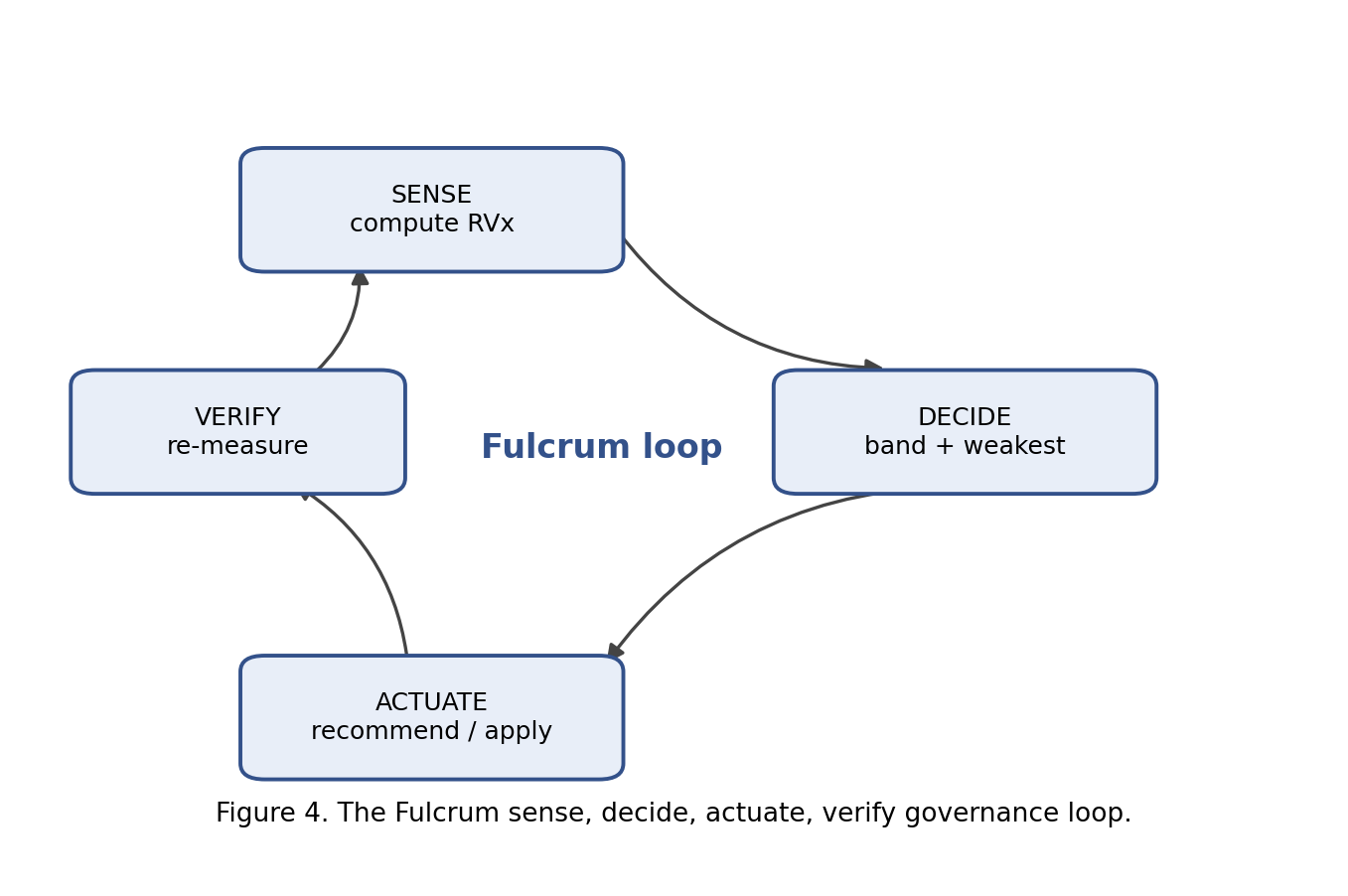
The umbrella method: a sense-decide-actuate-verify loop that turns the RVx score into a governed, gated decision, from a pull-request advisory to a CI/CD fitness gate.
The bounded, diagnostic composite of E, S, and L, with proved structural properties and a normalization that makes thresholds portable across systems.
Applies RVx at portfolio scale so leadership can govern granularity across a whole estate, with an incident-freeze rule that keeps it an assessment, not a marketing ladder.
Turns the qualitative choreography-versus-orchestration choice into a repeatable score from transaction complexity, business risk, and cross-service interactions.
The same three-signal form reinterpreted for AI-agent tool boundaries under the Model Context Protocol: an over-tooled agent is a distributed monolith of tools. Proposed, not yet validated.
Splitting to reduce complexity increases it when a boundary turns an in-process call into a network call without removing the coupling. Detectable only by reading all three signals together.
A boundary earns the name when its value (the joint product of efficiency, independence, and ownability) clearly exceeds the distributed complexity it introduces; one that fails this is a distributed-monolith fragment in function.
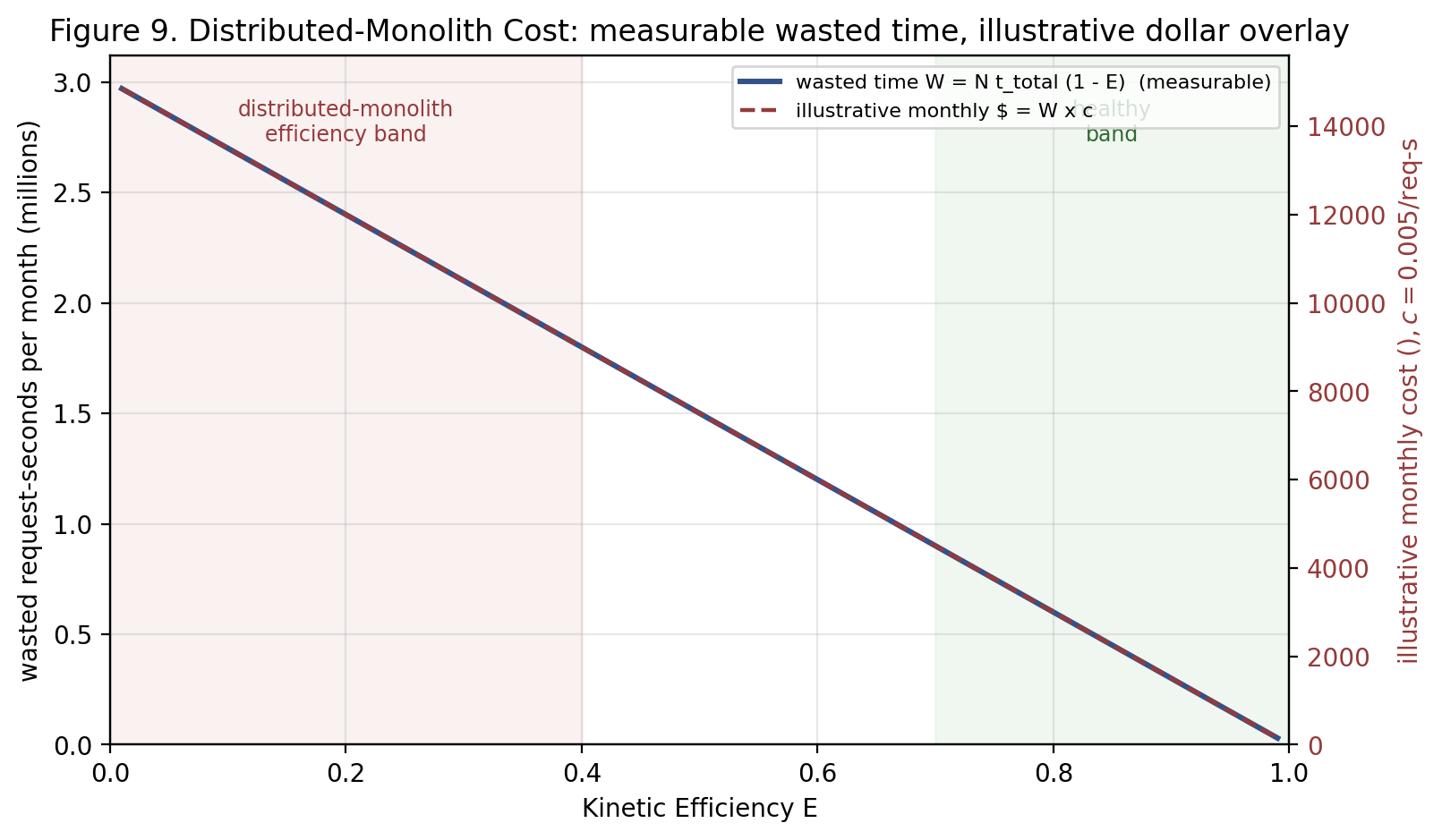
Prices the failure Khan's Law names, with a measurable core, the wasted transaction-time W = N × t × (1 − E), computed from the same traces as E, plus an illustrative dollar overlay.
Turn tool selection into a governed loop: keep the agent's context load below its collapse threshold by surfacing only the relevant tool subset per query, then verify by task success.
▶ Explore RVx, RVx-A, and SCS in the calculator → - ▶ Khan family simulations →
The full set defined in Appendix E of the paper. The primitives it builds on (coupling, cohesion, Conway's Law, sagas) are prior work and credited; what is new is the synthesis.
Guidance for applying each is in the paper section shown, and the practitioner one-pager; how to measure E, S, and L is built into the calculator.
Fulcrum is a closed loop: sense the three signals per boundary, decide against a calibrated band, actuate as an advisory or a safety-gated change, and verify the effect before it is trusted. It runs as a fitness function in CI/CD, so new distributed monoliths are caught before they ship.


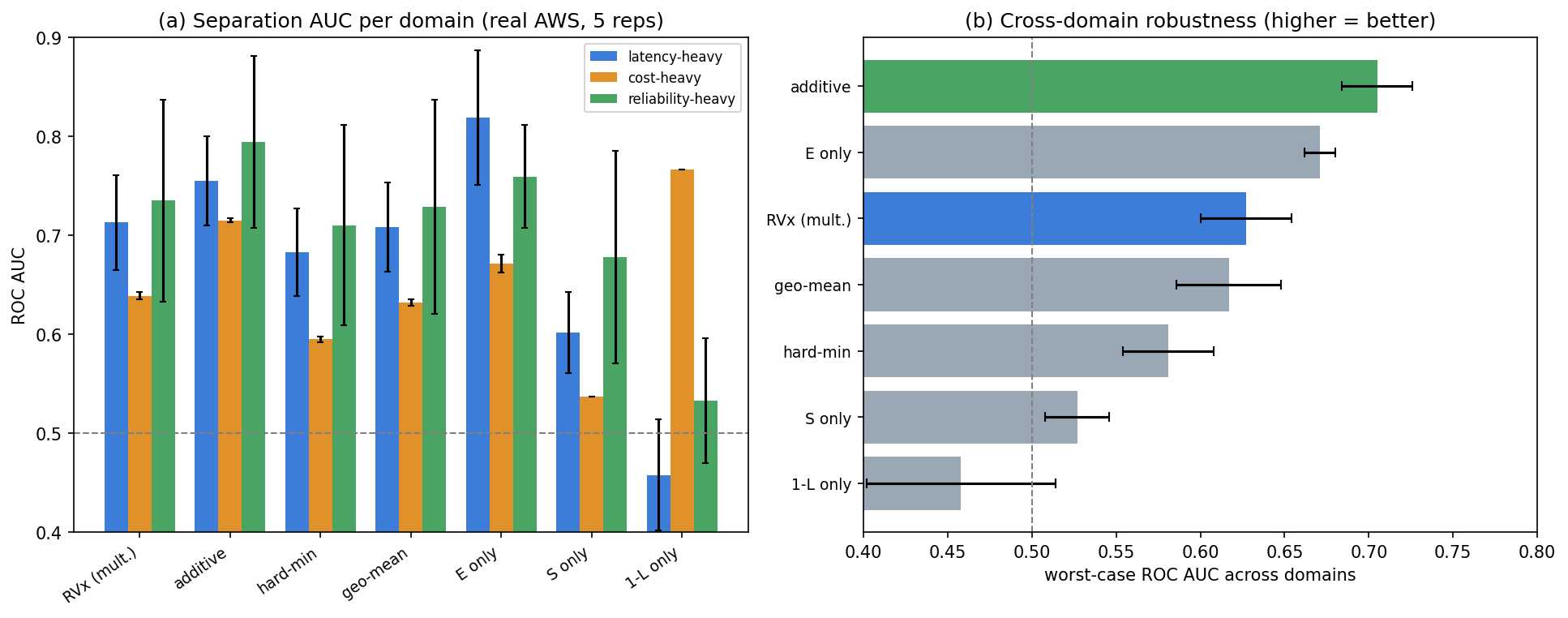
On a replicated 36-boundary AWS Lambda estate (paper Sec 12.11, five replications), each signal tracked its own independent outcome (E↔latency, L↔cost, S↔errors), and a fused composite was the most robust scorer across domains. That is construct-validity evidence on a deployed benchmark; the paper’s organic-production study is specified but not yet run, and this benchmark does not substitute for it. The harness is open-source and reproducible.
Key diagrams from the research. Open the calculator to score your own estate against the same math.
Move three sliders, or paste your services as name,E,S,L and rank them. All math matches the paper. No install, runs in your browser.
Fulcrum: Quantitative, Governed Granularity for Microservice Boundaries with the RVx Index. Viquar Khan, 2026. ORCID 0009-0008-3592-4162.
arXiv (link coming soon) - Code & reproduction on GitHub - Practitioner one-pager
Provenance. This is the rigorous research treatment of ideas the author has developed openly since 2017 in the free field guide Microservices Recipes - The Architect's Field Guide (read online - GitHub), where Fulcrum appears as the Adaptive Granularity Governance chapter.