
Microservices Recipes
The Architect’s Field Guide
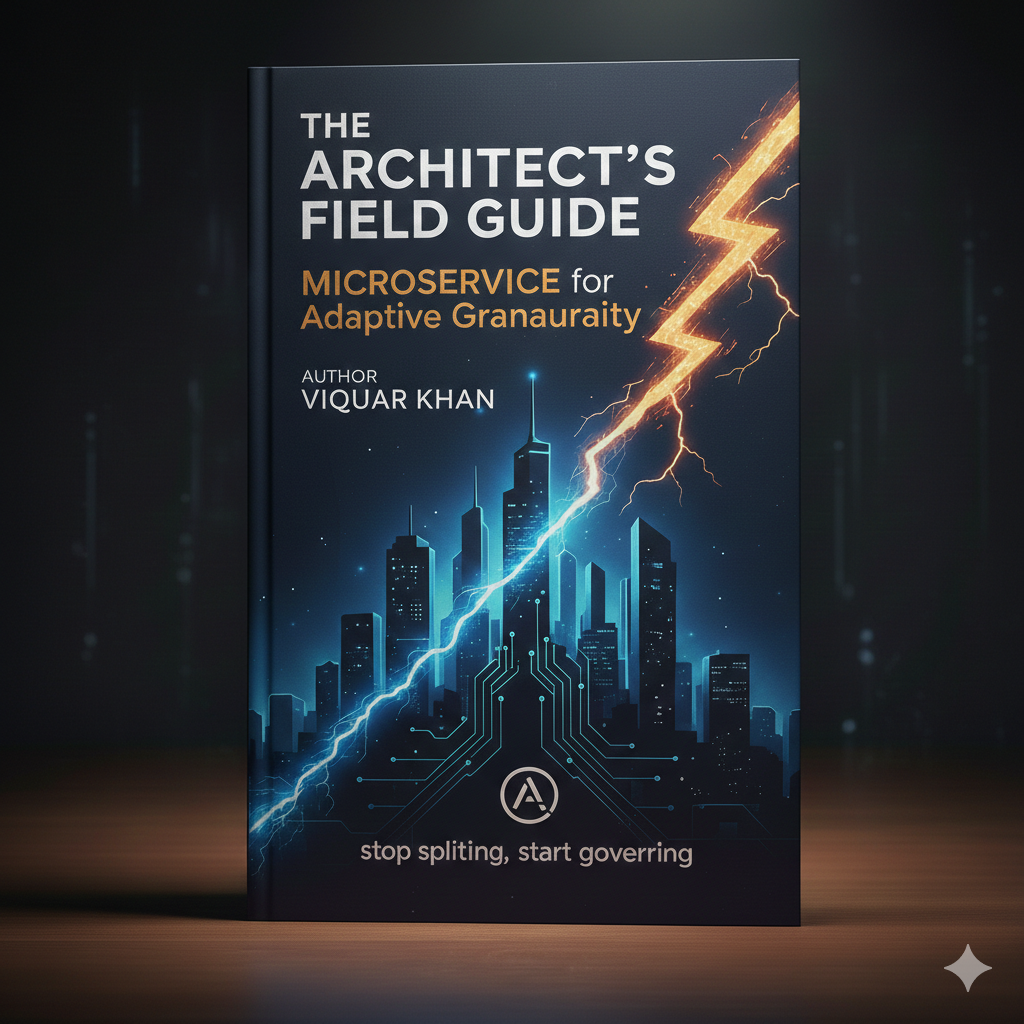
Adaptive Granularity Governance: The Khan Microservice Pattern
by Viquar Khan
Version 2.1 · 23 chapters · September 2026
A service boundary is worth deploying separately only when it earns its distributed cost. Chapter 11 is the measurement. Fulcrum / RVx is the research.
Start here

Contents
Front matter
- Preface - why a boundary has to earn its keep
- About the Author - Viquar Khan
- Mentorship - 1:1 on ADPList
- Academic use - the full book is public; cite it
- Licensing - MIT for code; CC BY-NC-ND 4.0 for prose
- Naming - methodology title and attribution
- Citations - how to cite this work
- Copyright - owner and dual license
- Disclaimer - legal notice
- Contributing
- Version history
- Changelog
Part I - The sociotechnical substrate
Align the shape of the organization with the shape of the architecture.
| 1 | Earned Boundaries, Not Fashionable Ones | 35 min |
| 2 | The Distributed Monolith: Diagnosis and First Remedies | 40 min |
| 3 | Decouple the Language Before You Decouple the Code | 40 min |
Part II - Data architecture
Splitting a system splits its data.
| 4 | The End of ACID | 45 min |
| 5 | The Consistency Tax of Spanning Services | 45 min |
| 6 | Close the Dual Write, Then Survive Failure | 45 min |
| 7 | Every Hop Is a Door. Prove Who Is Knocking. | 50 min |
Part III - Evidence between processes
You cannot attach a debugger to the space between services.
| 8 | You Cannot Attach a Debugger. Emit the Evidence First. | 50 min |
| 9 | There Is No Whole System to Test. Test the Agreements. | 50 min |
| 10 | Publish What Happened. Do Not Wait. | 50 min |
Part IV - Adaptive Granularity Governance
The score. Chapter 11 is the only source of truth for the formula.
| 11 | A Boundary Earns Its Keep Only When All Three Hold | 70 min |
Part V - Resilience and scale
| 12 | A Single Bad Shard Should Be a Footnote | 55 min |
| 13 | Break It on Purpose. Watch. Then You Know. | 55 min |
Part VI - Platform
| 14 | The Definition Is the Truth. Reality Is Reconciled Toward It. | 55 min |
| 15 | Spend the Budget on Answers. Stay Sighted When It Counts. | 55 min |
Part VII - Agents and retrieval
| 16 | The Model Proposes. The Executor Disposes. | 55 min |
| 17 | Retrieval as a Data-Plane Discipline, Not a Prompt Trick | 55 min |
Part VIII - Migration
| 18 | The Right Number of Services Is Often One. | 55 min |
| 19 | Replace It While It Is Still Running. | 55 min |
Part IX - Organizational maturity
| 20 | Has This Organization Earned the Right to Distribute? | 50 min |
Part X - The science behind the metric
| 21 | Price the Waste. Name the Rest. Do Not Invent a Total. | 50 min |
| 22 | A Formula Confers No Truth. Outcomes Do. | 50 min |
| 23 | Never Point the Number at the People. | 50 min |
Reference
The method
A boundary is worth deploying separately only when it is efficient at runtime, independent in how it changes, and small enough for its team to own. Chapter 11 measures that. Chapter 23 is the rule that keeps the measurement honest: do not use the score to review people.
The author
Viquar Khan is a Senior Data Architect at AWS Professional Services. He has kept this book in public on GitHub from the January 2019 notes through Version 2.1. On Stack Overflow his helpful posts have 7.5 million people reached.
Mentorship on ADPList. ORCID · LinkedIn · GitHub
Colophon
Copyright © 2019–2026 by Viquar Khan. Dual license: MIT for code; CC BY-NC-ND 4.0 for prose and figures. See LICENSING.md.
First edition January 2019. Second edition January 2026. Version 2.1 September 6, 2026. DOI 10.5281/zenodo.22654421. Citations · Copyright · Disclaimer