Aegis Gateway 2.0
Aegis 2.0 architecture
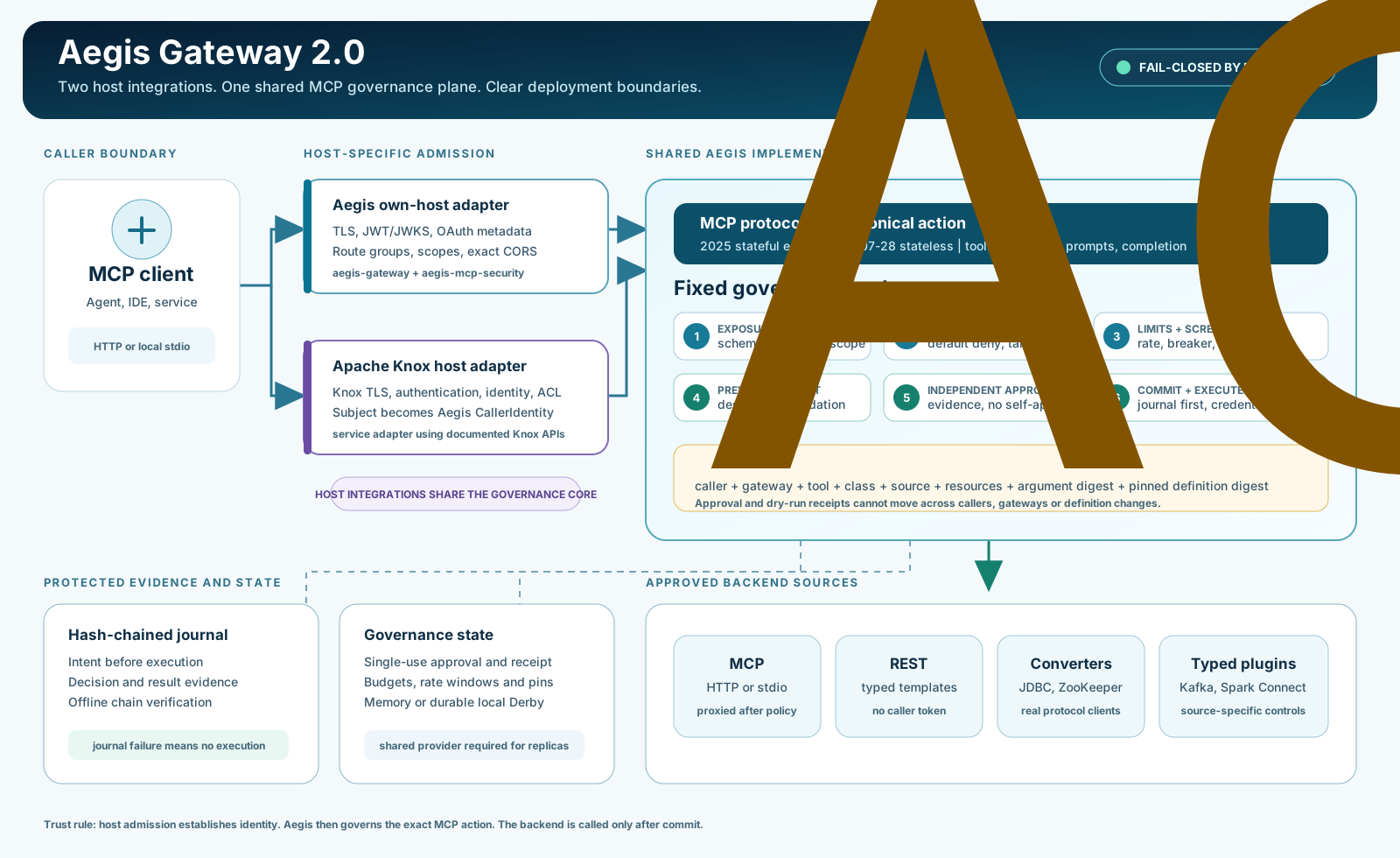
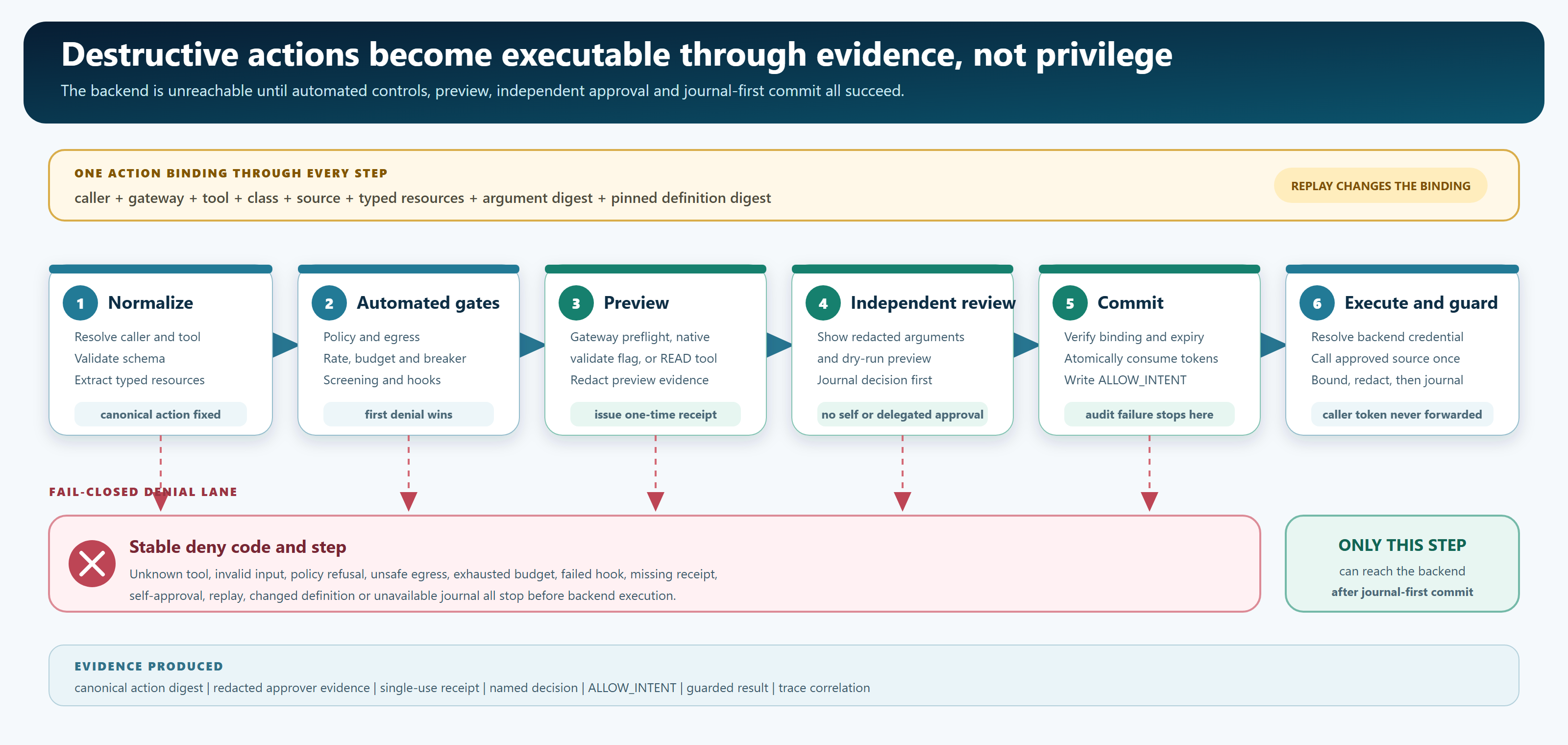
The first image embeds the accessible architecture SVG; the second embeds the validated 2x PNG
governance-flow render. Both diagrams are maintained as self-contained SVG sources with validated 2x
PNG renders. The governance-flow SVG source is the editable
source for the displayed PNG. Re-render them with
node tools/render_svg_png.mjs <input.svg> <output.png> 2. The Mermaid blocks below remain separate
editable detail views. DocumentationAssetsTest parses the SVGs, checks PNG signatures/dimensions and
resolves every documentation link; Mermaid blocks are rendered by mermaid-cli (mmdc) when a local CLI is configured.
1. Shape
One engine, two front doors, three kinds of backend. Every arrow into the engine carries a
CallerIdentity that the host established. After durable ALLOW_INTENT, every backend call carries
either a static gateway service credential or an exchanged backend-audience token. The verified inbound
caller token itself is never forwarded to the backend.
flowchart TB
    subgraph clients["MCP clients (agents, IDEs, desktop apps)"]
        C1["Streamable HTTP client<br/>2025-03-26 .. 2026-07-28"]
        C2["stdio client<br/>(local desktop)"]
    end

    subgraph doorA["Front door A: aegis-gateway + aegis-mcp-security"]
        S1["JDK HttpServer (TLS optional)"]
        S2["JwtVerifier (JWKS / HS256)<br/>or hashed static tokens"]
        S4["OwnServerPerimeter<br/>route groups, exact-origin CORS"]
        S3["StdioHost<br/>(configured identity)"]
    end

    subgraph doorB["Front door B: Apache Knox 3.0 topology"]
        K1["Knox authentication<br/>Shiro, KnoxSSO, JWT federation"]
        K2["identity assertion + AclsAuthz"]
        K3["AegisMcpResource (JAX-RS)<br/>KnoxIdentityBridge"]
    end

    subgraph core["Host-neutral core (zero third-party runtime dependencies)"]
        H["aegis-mcp: McpServerHandler<br/>both protocol eras, header checks,<br/>AdminApi (approvals, catalog, prompts)"]
        E["aegis-engine: GovernanceEngine (tools)<br/>ContentGovernor (resources, prompts, completion)"]
        CAT["ToolCatalog + prompt catalog<br/>CatalogIntegrity pins"]
        SPI["SPI: PolicyDecisionPoint, StateStore, AuditSink,<br/>CredentialProvider, GovernanceHook, DecisionListener"]
    end

    subgraph backends["Backends (unchanged projects)"]
        B1["Existing MCP server<br/>HTTP or stdio"]
        B2["REST API<br/>Flink, Spark UI, Iceberg REST, Kafka Connect"]
        B3["Java client plugin<br/>JDBC, ZooKeeper, Kafka Admin,<br/>Spark Connect (gRPC)"]
    end

    C1 --> S1 --> S2 --> S4 --> H
    C2 --> S3 --> H
    C1 --> K1 --> K2 --> K3 --> H
    H --> E
    E --- CAT
    E --- SPI
    E -->|"McpProxyToolSource / McpContentSource"| B1
    E -->|"HttpToolSource"| B2
    E -->|"ToolSourceFactory (ServiceLoader)"| B3
aegis-config builds the shared graph from one file: hosts call
GatewayFactory.build(file, BuildContext) and receive a Gateway (engine, MCP handler, admin API,
metrics). Host adapters perform different admission steps, then call the same governance implementation.
Equivalent Aegis configuration and normalized identity therefore traverse the same chain; host-level
results can differ because Knox and the own host intentionally authenticate and admit routes differently.
| Module | Role | Runtime dependencies |
|---|---|---|
aegis-engine |
chain, strict JSON, controls, audit, state, trace context, metrics | none (JDK 17) |
aegis-mcp |
MCP server handler (both eras), admin API, HTTP and stdio downstream clients | engine |
aegis-observability-otlp |
bounded asynchronous OTLP/HTTP span exporter, a DecisionListener |
engine, mcp |
aegis-config |
strict JSON/YAML config, declarative HTTP tools, OPA, built-in hooks, plugin, hook and state provider loading | engine, mcp, observability-otlp; snakeyaml optional |
aegis-mcp-guardrails |
optional project-governance hook |
engine, config |
aegis-mcp-security |
own-host perimeter: JWT/JWKS and static-token identity, RFC 9728 metadata, route groups, exact-origin CORS | engine, mcp, config |
aegis-gateway |
JDK HTTP(S) binding, stdio host, /metrics, shaded runnable jar |
config, mcp-security, mcp-guardrails, state-derby, snakeyaml |
aegis-source-jdbc / aegis-source-zookeeper |
typed converter sources (type: jdbc, type: zookeeper) |
config; the engine’s own client |
aegis-state-derby |
optional state.type: derby-local provider |
config; Apache Derby |
aegis-knox3-extension |
Knox 3.0 Service API (JAX-RS), Subject bridge, lifecycle | config; Knox 3.0.0 provided |
examples/aegis-examples |
Kafka Admin plugin, and the tests that load every file in adopters/configurations/ |
config; kafka-clients optional |
examples/aegis-spark-connect |
Spark Connect plugin (type: spark-connect) |
config, Spark Connect JVM client |
examples/aegis-gateway-spark / aegis-gateway-kafka |
runnable jars: gateway plus the Spark Connect or Kafka Admin plugin | gateway and the plugin |
2. Why the core has zero third-party dependencies
The engine must run inside hosts that bring their own libraries. Apache Knox 3.0.0 ships Jackson
2.18.9, snakeyaml 2.4 and Jersey 2.47 (read from its dep/ directory during the cold-install
test), and each Apache engine ships its own versions again. A private, strict JSON parser removes
every version collision. It also enforces properties that matter to a gateway: duplicate keys are
rejected, and depth and size are bounded during the parse. If a proxy and a backend disagree on
which of two "name" keys wins, the gateway’s check can be bypassed. YAML support is optional and
uses the host’s snakeyaml when present. Heavy clients (Kafka, Spark Connect) live in plugin
modules, so a deployment only carries what it configures.
3. Identity and credentials are separate
CallerIdentity carries who the caller is (actor, effective subject, groups, issuer, delegation
chain) and deliberately carries no credential.
- Own server:
JwtVerifierenforces an algorithm allow list, exactiss, requiredaud, bounded clock skew, and a bounded JWKS cache that fails closed once expired. RFC 8693actclaims become the actor chain. Static tokens are stored as SHA-256 digests and compared in constant time. - Knox:
KnoxIdentityBridgereads the Subject that Knox’s provider chain established:PrimaryPrincipal,ImpersonatedPrincipal,GroupPrincipalandActorChainPrincipal.
Backend credentials come from a CredentialProvider, which is called only after pre-execution
controls pass and durable ALLOW_INTENT succeeds. Depending on source configuration, the provider
returns either a static gateway service credential or an RFC 8693 exchanged, caller-bound
backend-audience token. The verified inbound caller token is used only as subject input to the
configured token endpoint and is never forwarded to the protected backend.
4. The tool chain and its ordering
sequenceDiagram
    autonumber
    participant C as MCP client
    participant H as McpServerHandler
    participant G as GovernanceEngine
    participant A as AuditSink (hash chain)
    participant P as CredentialProvider
    participant B as Backend

    C->>H: tools/call (+ _meta: traceparent, approvalToken, dryRunReceipt)
    H->>H: era, headers == body (Mcp-Method, Mcp-Name), size and JSON limits
    H->>G: ToolCall + CallerIdentity
    G->>G: 1 exposure, 2 input and scope, 3 policy (PDP)
    G->>G: 5 egress (every URL and DNS answer), 6 rate and budget, 7 breaker
    G->>G: 8 screening + hooks, 4 approval verify, 9 dry-run receipt verify
    G->>G: commit: consume approval and receipt in separate atomic nonce operations
    G->>A: ALLOW_INTENT
    alt audit write fails
        G-->>C: AUDIT_UNAVAILABLE (nothing executed, consumed controls stay consumed)
    end
    G->>P: credentials for this source (only now)
    G->>B: execute (traceparent forwarded, caller token never)
    B-->>G: result
    G->>G: hooks after, redact every string, bound bytes
    G->>A: EXECUTION_RESULT (result digest, redaction count)
    G-->>C: result + _meta decision (requestId, traceId, receipt, approval id)
Design choices:
- Enforcement controls fail closed. An exception or ambiguous result in a configured enforcement
control denies. Failure to append mandatory
ALLOW_INTENTprevents backend execution. AdvisoryAUDIThooks,DecisionListeners, metrics, and trace exporters are isolated observers: their failures are logged and ignored and cannot grant access or break an enforcement decision. - Verify, then commit. Approval tokens and dry-run receipts are verified at their steps but
consumed only at commit. Each nonce operation is atomic, so two concurrent calls cannot both use
one value, but approval consumption, receipt consumption, and
ALLOW_INTENTappend are a nontransactional, at-most-once sequence. If intent append fails after either value is consumed, nothing executes and fresh controls are required. - Approval last among the checks. Approval is evaluated after the automated controls, so approvers only see calls that would otherwise run. It is still recorded as step 4, for 0.1 audit compatibility.
- Intent before execution.
ALLOW_INTENTis written to the journal before the backend is contacted. If it cannot be written, the call is not executed (AUDIT_UNAVAILABLE). - One canonical action. Policy, approval, receipts and audit all bind to
Action: tool, class, source, resources, and the SHA-256 of the canonical backend arguments. What was approved is exactly what runs.
The dry-run path (validate, run, promote) is the same chain with a preview executor:
stateDiagram-v2
    [*] --> Requested: DESTRUCTIVE call, no token
    Requested --> Previewed: same call with _meta dryRun=true
    Previewed --> Approved: a different approver decides (admin API)
    Previewed --> Denied: approver denies
    Approved --> Executed: token + receipt, same caller, same action binding
    Executed --> [*]
    Approved --> Refused: replay, other arguments, other caller, changed definition, other gateway, expired
    Refused --> [*]
    Denied --> [*]
Preview modes: GATEWAY (the gateway answers, nothing reaches the backend), ARGUMENT (the
backend’s own validate-only flag, checked to exist in the schema), TOOL (a separate read tool,
for example spark_explain_sql for spark_sql).
5. Catalog integrity (tools and prompts)
Every tool definition (name, title, description, input/output schema, annotations) and every prompt definition (name, description, arguments) is digested.
- Pins: configured pins are authoritative. In TOFU mode, the first-seen digest is pinned and
persisted to an optional pin file. Prompt pins use the key
prompt:<name>. Under a signedserverCatalog, that key must be in the record of the source that advertised the prompt; another source’s same-named pin cannot authorize it. - Changed definitions: quarantined, hidden from
tools/list/prompts/listand denied withCATALOG_INTEGRITYuntil an operator accepts the exact reviewed digest usingPOST /catalog/{tool}/acceptorPOST /prompts/{prompt}/acceptwith oneAegis-Definition-Digest: sha256:...header. Configured pins cannot be overridden from the API. - Poisoned descriptions: definitions that match poisoning phrases are quarantined.
- Duplicate names: a name offered by two sources aborts startup. On refresh, a bad listing keeps that source’s previous entries instead of applying half of it.
- Classification: tool class comes from the operator, and unclassified proxied tools default to DESTRUCTIVE. Upstream annotations may raise the class, never lower it.
6. Protocol eras
| 2025-03-26 .. 2025-11-25 (legacy) | 2026-07-28 (modern) | |
|---|---|---|
| Selected by | initialize |
params._meta["io.modelcontextprotocol/protocolVersion"] |
| Session | optional Mcp-Session-Id, caller-bound (another principal gets 404) |
none; Mcp-Session-Id ignored |
| Headers | MCP-Protocol-Version checked against the session; Mcp-Method / Mcp-Name checked when present |
MCP-Protocol-Version, Mcp-Method, Mcp-Name required and must equal the body (else 400 / -32020) |
| Discovery | initialize result |
server/discover |
| List results | {tools} |
{tools, resultType, ttlMs, cacheScope:"private"} (lists are per caller) |
| Notifications | notifications/initialized, notifications/cancelled accepted (202) |
same |
Governance state (approvals, receipts, budgets, pins) never hangs off a session. It is keyed by caller identity and action, so the same controls hold in both eras.
Downstream, HttpMcpClient in AUTO mode probes modern first and falls back to legacy, as the
2026-07-28 backward-compatibility section describes. It re-establishes an expired legacy session
once, parses SSE responses, and refuses server-to-client requests on a legacy stream (sampling,
elicitation), because they would reach the model outside governance.
Multi Round-Trip Requests (MRTR) work for tools/call, resources/read and prompts/get, the
three requests the specification allows:
- The client’s declared
elicitation/sampling/rootscapabilities are forwarded downstream, so a compliant backend knows what it may ask for (and nothing more). - A backend’s
input_requiredresult (inputRequests,requestState) is relayed to a 2026 client after redaction (and, for resources and prompts, the content screen). - The client’s retry is a new request, governed again from step 1. Its
inputResponsesare screened like arguments (injection, embedded URLs),requestStateis size-bounded and forwarded unchanged (integrity is the backend’s job, as the specification requires), and an approval token is single use, so a retried approval-gated call needs a fresh approval. - A 2025 client cannot carry
inputResponses: it gets an explanatory error, and sending MRTR fields in a 2025 request is rejected (-32602).
7. Resources, prompts and completion
They cannot change backend state, but they put data (resources) and instructions (prompts) straight into the model’s context, so each governed read passes the same steps as a READ tool call.
flowchart LR
    R["resources/read uri<br/>prompts/get name<br/>completion/complete ref"] --> X{"1 exposure<br/>route to exactly one source<br/>groups, prompt active"}
    X -->|no| D1["-32010 NOT_EXPOSED / CATALOG_INTEGRITY"]
    X --> I{"2 input + scope<br/>prompt args declared, strings, required"}
    I --> PL{"3 policy<br/>tool = MCP method, class READ<br/>resource mcp:resource:uri / mcp:prompt:name"}
    PL --> EG{"5 egress, 6 rate, 7 breaker,<br/>8 argument screen"}
    EG --> AU["ALLOW_INTENT audit"]
    AU --> EX["execute (credentials now,<br/>traceparent forwarded)"]
    EX --> SH{"result rebuilt from spec fields only,<br/>content URIs inside uriPatterns"}
    SH --> RD{"redact strings, refuse binary<br/>unless allowBinary, bound bytes"}
    RD --> CS{"8 content screen<br/>(what enters the model)"}
    CS -->|match| D2["-32010 PROMPT_INJECTION"]
    CS --> OK["result + EXECUTION_RESULT audit"]
- Off by default. An existing server’s resources and prompts are exposed only when the source
has a
resources/promptssection. Capabilities advertise only what is served. - Routing never guesses. A URI is served by the single source whose
uriPatternsmatch; zero or several matches isNOT_EXPOSED. A read cannot return contents with URIs outside the patterns. - Results are rebuilt, not relayed:
contents[]withuri,mimeType,textorblob;messages[]withroleandcontent;completion.valuescapped at 100. Unknown fields and upstream_metaare dropped. - Binary is explicit. Regular expressions cannot inspect or safely redact
blobdata, so it is refused unless the operator setsallowBinary. - Lists are filtered by exposure and patterns, redacted and screened item by item, and rate
limited; like
tools/listthey are not audited. A source that fails while listing is reported in_meta["io.github.vaquarkhan.aegis/unavailableSources"]rather than silently missing. - Prompt content is screened, not pinned: prompt messages are templates filled per call, so a digest of them would change on every request. The definition is pinned; the output is screened.
- Not offered:
resources/subscribe,resources/unsubscribe,logging/setLevel, and any server-to-client request. They are method-not-found and absent from capabilities, so nothing ungoverned is proxied. Governed subscriptions would need a per-notification decision and are a separate design, not a missing line of code.
8. Observability
- Audit (
AuditSink): hash-chained JSONL. A pre-execution denial normally emits one best-effortDECISION; a call that proceeds requires durableALLOW_INTENTand normally adds a best-effortEXECUTION_RESULTorDRY_RUN_RESULT. Event fields are present when applicable, such as identity, class, source, resources, argument digest, result digest, andhookAudit. Raw arguments appear only whenaudit.includeArgumentsis set. Failure to append mandatoryALLOW_INTENTblocks credentials and execution, while denial and terminal-result append failures are logged after the response outcome is already determined.--verify-auditchecks the chain offline. - Trace context (
TraceContext): W3Ctraceparentfrom_meta(the key OpenTelemetry uses for MCP) or the HTTP header, strictly validated (invalid values start a new root). The gateway is one hop: it records its own span id, returns the trace id in the decision_meta, and forwardstraceparentto HTTP backends (header) and MCP servers (header and_meta). It is propagation and correlation, not an exporter: no span is sent anywhere by the gateway itself. - Traces (
OtlpSpanExporter, off unlesstracing.otlp.endpointis set): one span per governed request, exported over OTLP/HTTP with a JSON body and no OpenTelemetry SDK dependency. The span uses the request’s own trace and span ids, so it joins the caller’s trace as a server hop. The request thread only enqueues; a daemon thread batches and posts, and a full queue drops and counts spans rather than adding latency. Attributes carry the request id, method, class, source, outcome and step, and never the caller, the arguments or the result: correlate to the audit journal onaegis.request_id. - Metrics (
DecisionListener,DecisionMetrics): counters by kind, method, source and outcome, backend calls, and a latency histogram, in Prometheus text format. Labels are bounded by configuration (unknown tool names fold into_unknown); callers and resources are never labels. A listener cannot change a decision, and a failing listener is logged and ignored. - Logs:
System.Logger(JUL by default, bridged by the host), catalog events (TOOL_ACTIVE,TOOL_QUARANTINED,PROMPT_*,SOURCE_UNAVAILABLE), no argument values.
9. State
StateStore holds single-use approval and receipt nonces, pending approvals, rate and budget windows,
and, when supported, signed-file serial high-water marks. Each store operation is atomic, but a sequence
of operations is not one transaction. TOFU tool and prompt pins are maintained by CatalogIntegrity
and optionally persisted to catalog.pinFile; they are not stored by StateStore or shared through
PostgreSQL. state.type selects the store (see CONFIGURATION.md):
memory(default): the boundedInMemoryStateStore, one replica, lost on restart.derby-local:DerbyStateStorefrom the optionalaegis-state-derbymodule, found through theStateStoreFactorySPI. It persists the same state in an embedded Apache Derby database without a database server, so it survives a restart of one process. Derby’s embedded lock lets one JVM open the database for writing, so it is a durable single-node choice, not an active-active store.postgres:PostgresStateStorefrom the optionalaegis-state-postgresmodule, for several replicas behind a load balancer. Replicas that name the samenamespaceshare single-use approval and receipt nonces, pending approvals and rate windows through one PostgreSQL database.
The postgres provider has a recorded 2026-10-08 run of five provider tests and one two-gateway test
against a temporary managed PostgreSQL instance; the engine version was not retained
(evidence). Two gateway JVMs sharing one PostgreSQL 17.6
namespace were also run: an approval requested on replica A was decided on replica B, the approved
delete ran once, the replay was refused, and one rate window applied across both
(evidence). Catalog pins and circuit breakers stay per process,
each replica writes its own audit journal, and PostgreSQL replication and failover were not tested
(see VALIDATION.md).
10. Deployment shapes
flowchart LR
    subgraph A["Own server (Aegis security)"]
        a1["agent"] -->|"HTTPS + JWT"| a2["aegis-gateway"] --> a3["Spark / Flink / Kafka / MCP server"]
    end
    subgraph B["Inside Apache Knox (Knox security)"]
        b1["agent"] -->|"HTTPS"| b2["Knox topology<br/>authn, identity assertion, ACL"] --> b3["AEGIS_MCP service<br/>(5 jars or 1 bundle in ext/)"] --> b4["Spark / Flink / Kafka / MCP server"]
    end
    subgraph C["Local desktop (stdio)"]
        c1["IDE / desktop app"] -->|"stdio"| c2["aegis-gateway --stdio"] --> c3["local or remote backend"]
    end
11. Trust boundaries
| Input | Trusted? | Handling |
|---|---|---|
| Operator config file | yes | strict parse; unknown keys fatal; secrets only via environment |
| Caller identity from host | yes (host’s job) | never anonymous; 401 without it |
| Request body | no | strict JSON, bounded, header/body match, schema subset, recursive screening |
| Upstream tool and prompt definitions | no | pinned, screened, class can only rise |
| Backend responses, resources, prompt messages | no | rebuilt from spec fields, bounded, redacted, content-screened, SSE server requests refused |
| DNS answers | no | every answer classified; private classes need an explicit CIDR |
traceparent |
no | strictly parsed; only ids are propagated |
12. Extending
GovernanceHook: extra controls over all four governed operations (tool calls, resource reads, prompt gets, completion), run in order.ENFORCEfailures deny;AUDIThooks are advisory and isolated from the decision. Each is bound with a mode (ENFORCE,AUDIT,OFF) and optional conditions on operation, method, caller group and source (hooks: [{type, mode, operations, methods, groups, sources}]).type: remote: a hook in another process, reached over HTTP, for controls that are not written in Java. No jar, no classpath change.ToolSourceFactory: new backend kinds (type: <name>), for examplespark-connect.ContentSource: the engine SPI behind resources and prompts. Configuration builds it formcpsources (McpContentSource); an embedding host can supply its own implementation programmatically.PolicyDecisionPoint: another policy engine; OPA is bundled.AuditSink: a second sink, for example a host’s audit service. Both sinks must succeed.CredentialProvider: backend credentials per source; the built-in ones are static credentials and RFC 8693 token exchange (credentials.type: token-exchange, which reads the verified caller token from the request-scopedSubjectToken).GovernanceHookFactory: a Java hook discovered by ServiceLoader (hooks[].type: <name>); the optionalproject-governancehook inaegis-mcp-guardrailsis one.StateStoreandStateStoreFactory: another state provider selected bystate.type, for example shared state for several replicas.DecisionListener: metrics, alerting or a SIEM bridge (read-only).
13. Non-goals
Aegis is a governance and security checkpoint for MCP. It is not an MCP platform. Naming what is deliberately absent is part of the design, because every one of these is a reasonable thing to want and none of them belongs in the same artifact as the enforcement path.
| Not in Aegis | Why, and what to use instead |
|---|---|
| Server registry or catalog UI for discovering MCP servers | Discovery has its own lifecycle and access model. Aegis governs sources an operator has already configured, pinned and admitted. The optional signed serverCatalog is not a registry: it lists only sources already declared in the configuration and decides at startup whether each may start. |
| Federation, peer gateways, virtual servers composed from other servers | Composition multiplies the ways a tool can be exposed, and every extra path is a path the policy has to cover. One gateway, one configured set of sources |
| Admin web UI | The admin surface is a small JSON API (AdminApi) behind approver groups. A UI is a separate deployable, and it is where CSRF and session bugs live |
| An observability stack (dashboards, storage, alert rules) | Aegis emits hash-chained audit JSONL and Prometheus metrics. Where those go is the operator’s existing stack |
| WebSocket transport, REST or gRPC proxying of non-MCP APIs | Aegis governs MCP over HTTP and stdio. A declarative HTTP source exists to turn an API into governed MCP tools, which is the opposite direction: bring the API into the governed shape rather than widen the front door |
| LLM token accounting or cost budgeting | Aegis budgets calls by tool class. Token spend is a model-gateway concern and needs the model’s own accounting |
| An A2A front door | See ADR-001. Delegation to an agent is governed as a tool call through the a2a source, which is built; serving A2A to other agents is not |
| Being the model gateway, prompt store or agent framework | Aegis sits between an agent and real systems. It has no opinion about which model is used |
Two things Aegis deliberately keeps that comparable gateways make optional:
- Fail-closed is not configurable. A control that cannot run denies. Where a plugin framework
offers “continue on plugin error”, Aegis offers
mode: AUDITon a specific hook, which is an explicit, per-control, audited choice rather than a global switch. - Deny codes are a fixed registry. Extensions reuse it; they cannot invent wire codes, so a client never has to handle a code that only one deployment emits.
14. Own-host MCP security perimeter
The own-host option provides an Aegis-managed perimeter for deployments that do not use a Knox topology. Where Apache Knox is already the deployment perimeter, Knox supplies its established authentication, identity assertion, and route-admission capabilities before the same shared MCP handler:
TLS server -> identity resolver -> route groups -> body bound -> MCP/Admin handler -> GovernanceEngine
host.routes.mcpGroupsandhost.routes.adminGroupsare route admission controls. They run after identity resolution and before Aegis reads an MCP/admin body. They answer who may reach the route; the engine still answers who may call the exact tool and resource.host.corsis disabled by default. When enabled, it accepts exact configured origins only, answers preflight without authentication or body buffering, and requires its origin set to be a subset ofserver.allowedOrigins. This prevents a browser from receiving a permissive preflight for an origin the common MCP handler would deny.host.oauthpublishes RFC 9728 protected-resource metadata, addsresource_metadatato every protected-route 401, and refuses a resource that differs from the JWT audience unless the operator declares it. OptionalmcpScopes,adminScopesandmetrics.requiredScopesrequire every named scope and return RFC 6750insufficient_scopewhen a valid token needs step-up authorization.- These classes live in
aegis-mcp-security;aegis-gatewayonly binds them to the JDK HTTP server. The own-host executable does not contain the Knox extension.
Two related controls apply on every host, not only the own server:
state.type: derby-localkeeps governance state durable for one process (section 9).sources[].trustsupplies source-wideACTIVEorQUARANTINEDadmission. A quarantined source contributes no callable tool and must name an evidence reference. It composes with tool/prompt pins: source trust, tool integrity, policy and approval all have to permit an action.
The own-host and Knox integrations both converge on CallerIdentity and the shared MCP governance engine. The Knox service adapter uses public Knox APIs, while the own-host adapter provides the Aegis-managed edge. KnoxPackagingBoundaryTest records the packaging boundary between these integration choices. Runtime source registration, plugin installation, server federation and a registry UI remain outside this perimeter.