Hello World
Put Aegis into your IDE and Apache project development cycle: build, start a profile, point MCP at Aegis, send one prompt.
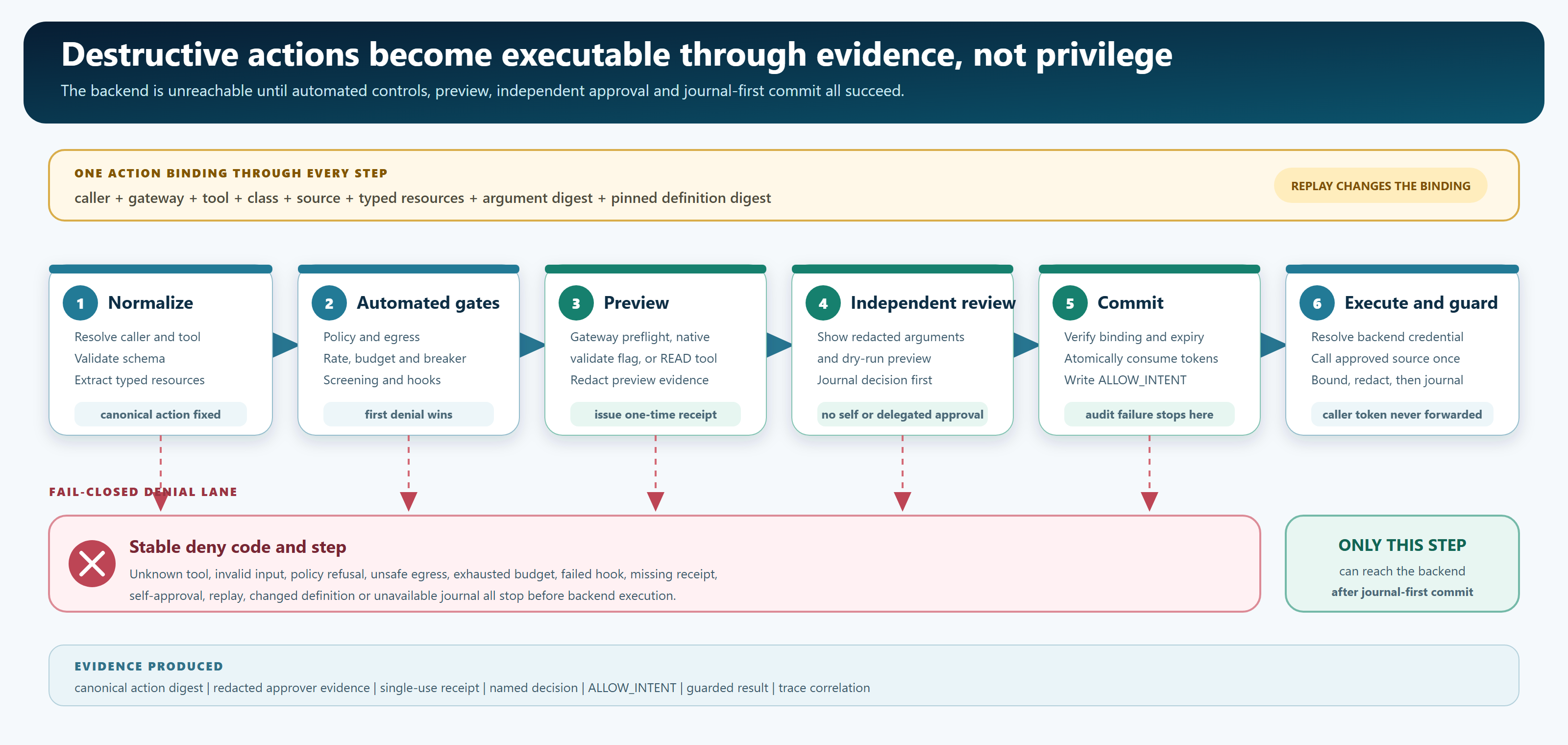
A configuration-driven governance layer for MCP calls. It gives agents one controlled route to real systems, with typed resources, approvals, destructive-action receipts, and locally verifiable audit evidence.
Start the Hello World Open the user handbook
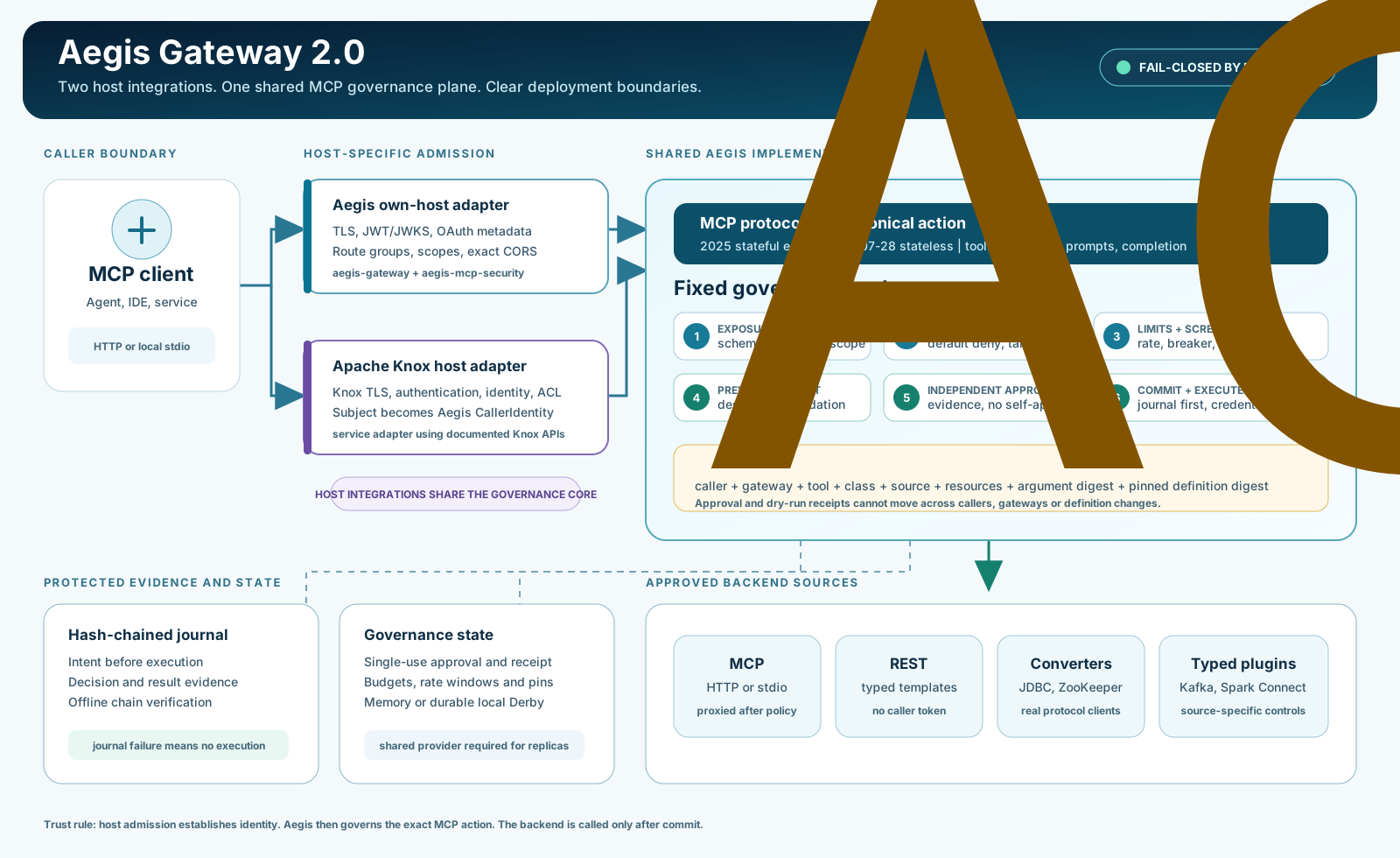
Put Aegis into your IDE and Apache project development cycle: build, start a profile, point MCP at Aegis, send one prompt.
A concise route map for application teams, operators, security reviewers, and plugin authors.
Trust zones, STRIDE abuse cases TM01 to TM10, OWASP MCP Top 10 handling, S1 to S31 promises, and dated control-suite records with their attestation status.
The complete control plane, the controls enforced today, and a direct list of the open findings, the components Aegis does not own, and the checks that need a cluster or runtime.
Three real MCP server CVE classes exploited directly, then denied or contained through Aegis, with before-and-after evidence from a real run.
Run the gateway image on EKS, ECS or EC2, then connect Kiro, Cursor, VS Code or Claude Desktop as a governed MCP server.
Where Aegis contributes: human oversight, accountability, privacy and least privilege at the MCP action boundary, mapped to NIST AI RMF and the EU AI Act.
Deep-dive walkthroughs and one IDE-ready tutorial per verified Apache project, each from a retained real run.
What each core root-reactor module does, its principal configuration keys, and the security controls it enforces.
A tiny Iceberg dataset, Spark Connect, and your IDE's agent governed by Aegis, with and without Knox. All tutorials.
Connect an MCP server, declare REST tools, or choose a typed source without changing the governed project.
Connect Aegis semantic governance to an existing Knox topology for perimeter, identity, and route admission.
Full S1 to S31 table, documented limits, the threat model, and security validation.
See dated regression records, test boundaries, and real-engine evidence classifications.
Build, configure, connect an IDE, operate approvals and audit, and write sources, hooks, state and secret providers while preserving the engine’s fixed governance boundary.
Start with the system you already operate. These guides connect a practical configuration, a governed MCP surface, and the evidence that describes what was exercised.
Find reference profiles for an existing MCP server, REST API, A2A agent, JDBC source, or Apache system. Each profile states its source type and evidence boundary.
Follow guided own-host and Knox paths for Kafka, Flink, Iceberg, Spark, ZooKeeper, and other verified project integrations.
Open the repository tutorial folder for ready-made VS Code, Kiro, and Cursor MCP settings. Start the matching gateway first and supply fresh local credentials.
Review the exact configuration, topology, engine settings, audit records, and result logs from retained integration runs. Evidence status remains explicit for every profile.
| Surface | Evidence status | Where to go next |
|---|---|---|
| Core governance | Default build on 2026-10-03: 364 tests in a 20-project reactor, 0 failures, 0 errors, 0 skipped, and a clean Apache RAT check. | Validation report |
| Adapter catalog | 25 deployable adapter configurations and 116 tools, parsed and governed in the default build. | Repository adopter catalog |
| Real-engine runs | Twenty-eight profiles have own-host and Knox runs, each with an IDE-ready tutorial. Four more ship as configuration for the next product-stack run: Atlas, Cassandra, Impala, and Paimon. | Adopter status |
| Security and threat model | Threat model (STRIDE, TM01 to TM10), security properties S1 to S31, and a focused control suite of 227 tests with 0 failures. | Security guide |
| Security hardening and build gates (2.0) | Hardened build on 2026-11-07: 408 tests across the eight core modules, 0 failures, with SpotBugs and the FindSecBugs plugin, JaCoCo coverage, and the Apache RAT license check all green. CodeQL and an OSV dependency scan are added as CI workflows. | Threat modeling |
| MCP CVE containment | Three real MCP server CVE classes (filesystem path traversal, command injection, arbitrary file access) exploited directly, then denied or contained through Aegis, with before-and-after evidence from a real run. | CVE containment |
| Added 2026-10-03 | Per-caller backend credentials by RFC 8693 token exchange (Keycloak 26.8.0), A2A agents as governed tools (a2a-sdk 1.2.1 through both front doors), an OpenAPI-to-draft command, three reference hook services, and a container image and Helm chart. | Runs added on 2026-10-03 |
| Knox extension | Knox 3.0.0 API-level tests, and a 2026-10-05 run of the current bundle inside a stock Knox 3.0.0 gateway against real ZooKeeper. Knox 3.1 needs a Jakarta build. An operator must validate their Knox topology and plugin set. | Knox extension guide |