TM01 Prompt-injected destructive call
Untrusted context steers a privileged caller. Expect policy, approval, and receipt binding before any backend write.
SECURITY REVIEW
This page is the HTML entry for security reviewers. It summarizes the product threat model, the S1 to S31 promises, and dated control-suite records with their attestation status. Full tables and abuse-case detail stay in the linked rendered documents so evidence stays auditable.
BOUNDARY
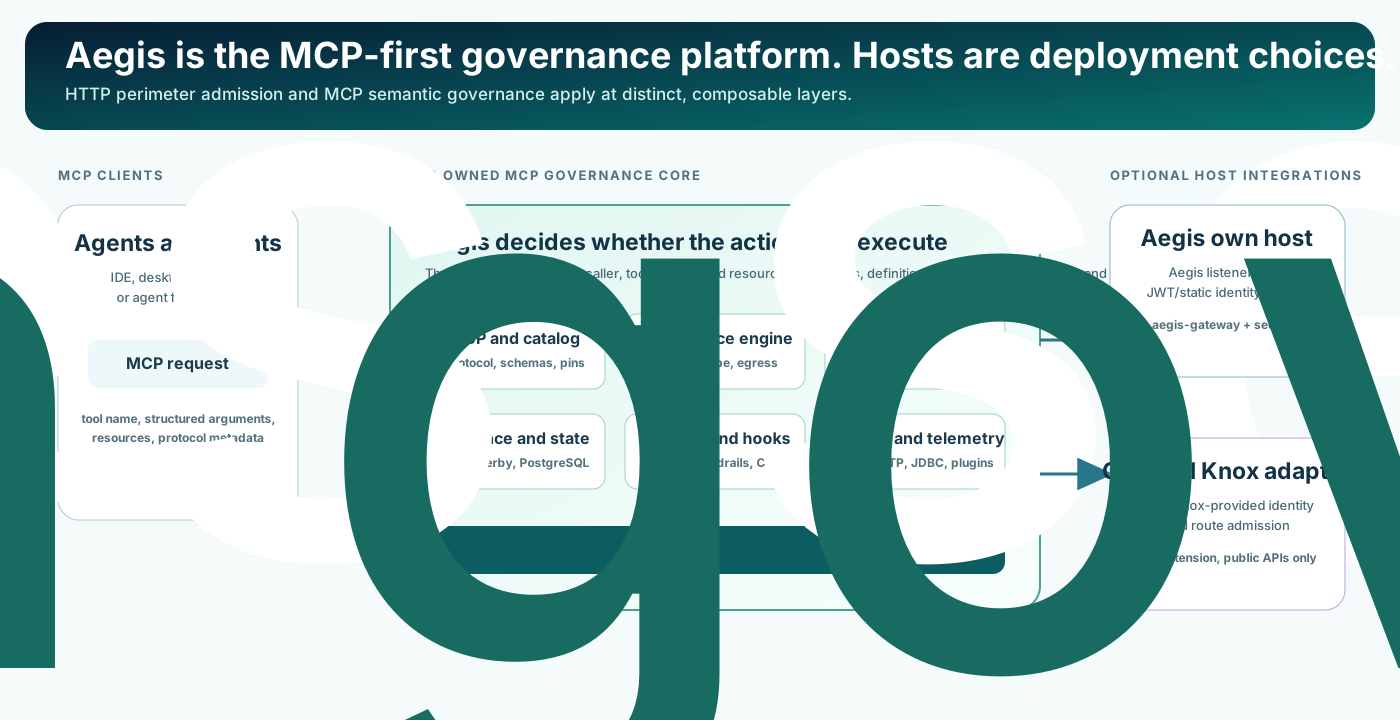
Aegis is reviewed as the MCP decision plane after host identity is established and before a source presents a backend credential. Own-host and Knox are front-door choices; both feed the same governance engine.
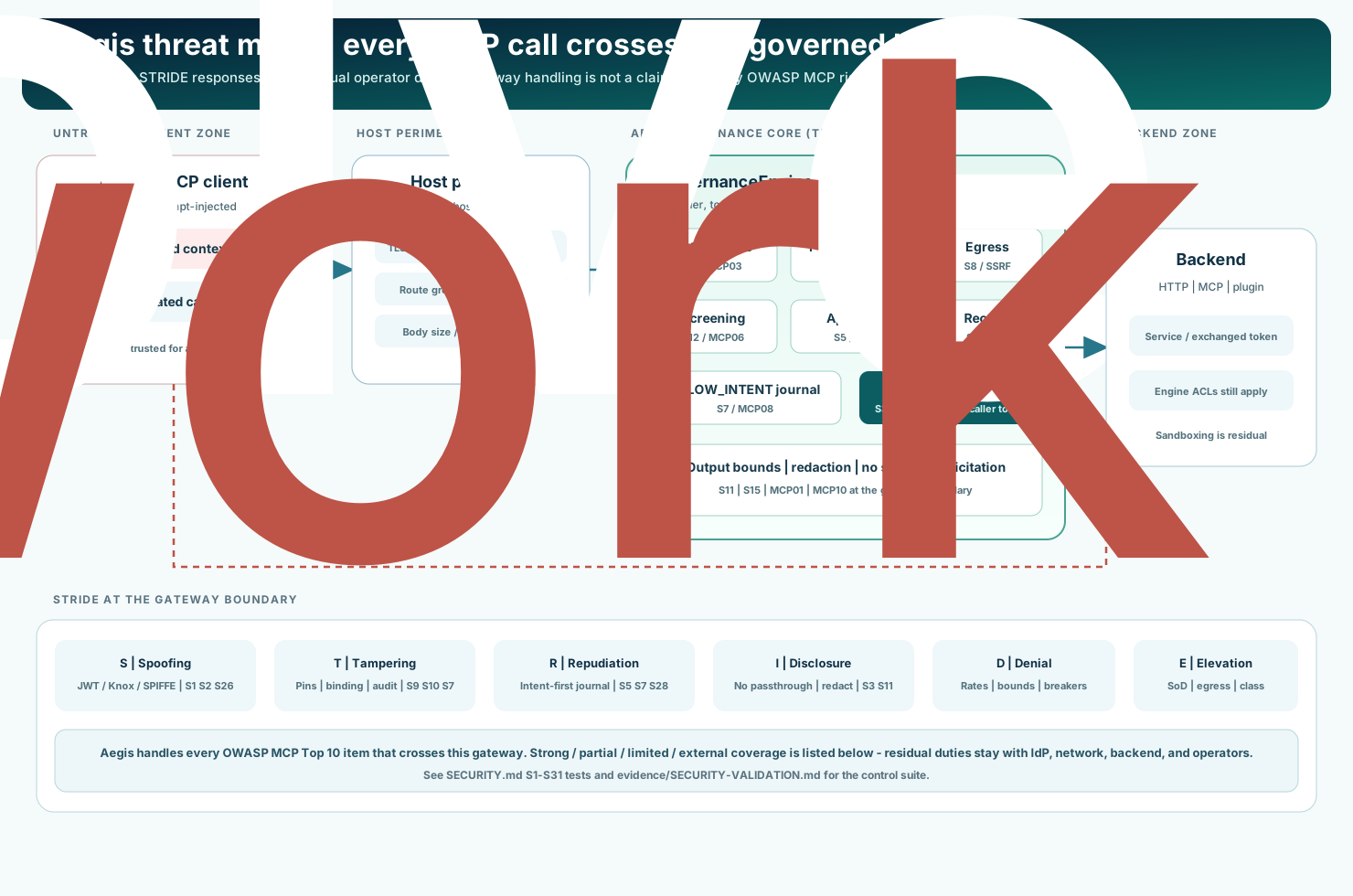
Tool, resource, prompt, and completion calls; catalog pinning; approvals and receipts; egress; audit; hooks; output bounds; declarative HTTP and typed sources as capability only.
Model training and RAG poisoning, agents that never call Aegis, backend-internal ACLs beyond the gateway credential, discovery of shadow MCP servers off this path, and host OS or SIEM product choice.
Cross-zone rule: a call may not present a backend credential until the governance core has written ALLOW_INTENT (or denied). Caller tokens never enter the backend zone for protected backends.
TRUST ZONES
| Zone | Components | Posture |
|---|---|---|
| Z1 Client | Agent, IDE, MCP client, untrusted documents | Untrusted for authorization |
| Z2 Host perimeter | TLS, JWT/JWKS/static/SPIFFE, Knox Subject, CORS, routes, scopes | Trusted only after verification |
| Z3 Governance core | Catalog, policy, egress, screening, approval, receipt, hooks, audit | Fail-closed MCP action root |
| Z4 Sources | HTTP, MCP proxy, plugins | Capability only; must not bypass Z3 |
| Z5 Backend | Engines that receive the gateway credential | Trusted for own responses; ACLs still required |
| Z6 Operator / IdP / network | Config, pins, secrets, firewall, inventory | External residual owners |
STRIDE AND ABUSE
The threat model elaborates STRIDE per zone into abuse cases TM01 to TM10. Each case states preconditions, attacker goal, expected gateway outcome, and the S-property that owns the proof.
Untrusted context steers a privileged caller. Expect policy, approval, and receipt binding before any backend write.
A changed tool definition is quarantined; prior approvals and receipts do not bind the new digest. With a signed serverCatalog, only the reviewed pins can bind and run-time acceptance is refused.
Inbound caller tokens are not forwarded to protected backends; token exchange is egress-checked and subject-bound.
Nested HTTP(S) arguments and DNS answers pass egress classification; redirects are not followed.
Classification, sql-readonly hooks, and least-privilege credentials contain the call; fail closed on ambiguity.
Requester cannot approve under an alternate spelling; delegated identities cannot approve.
External residual: Aegis cannot govern a path that never reaches it. Network inventory remains operator work. For servers behind Aegis, a signed serverCatalog limits which may start, and a break-glass order can contain one during an incident.
Post-delivery disclosure, supply-chain pin trust, and host CSRF/Origin checks are covered in the full model.
Read every TM01 to TM10 scenario with preconditions and expected outcomes.
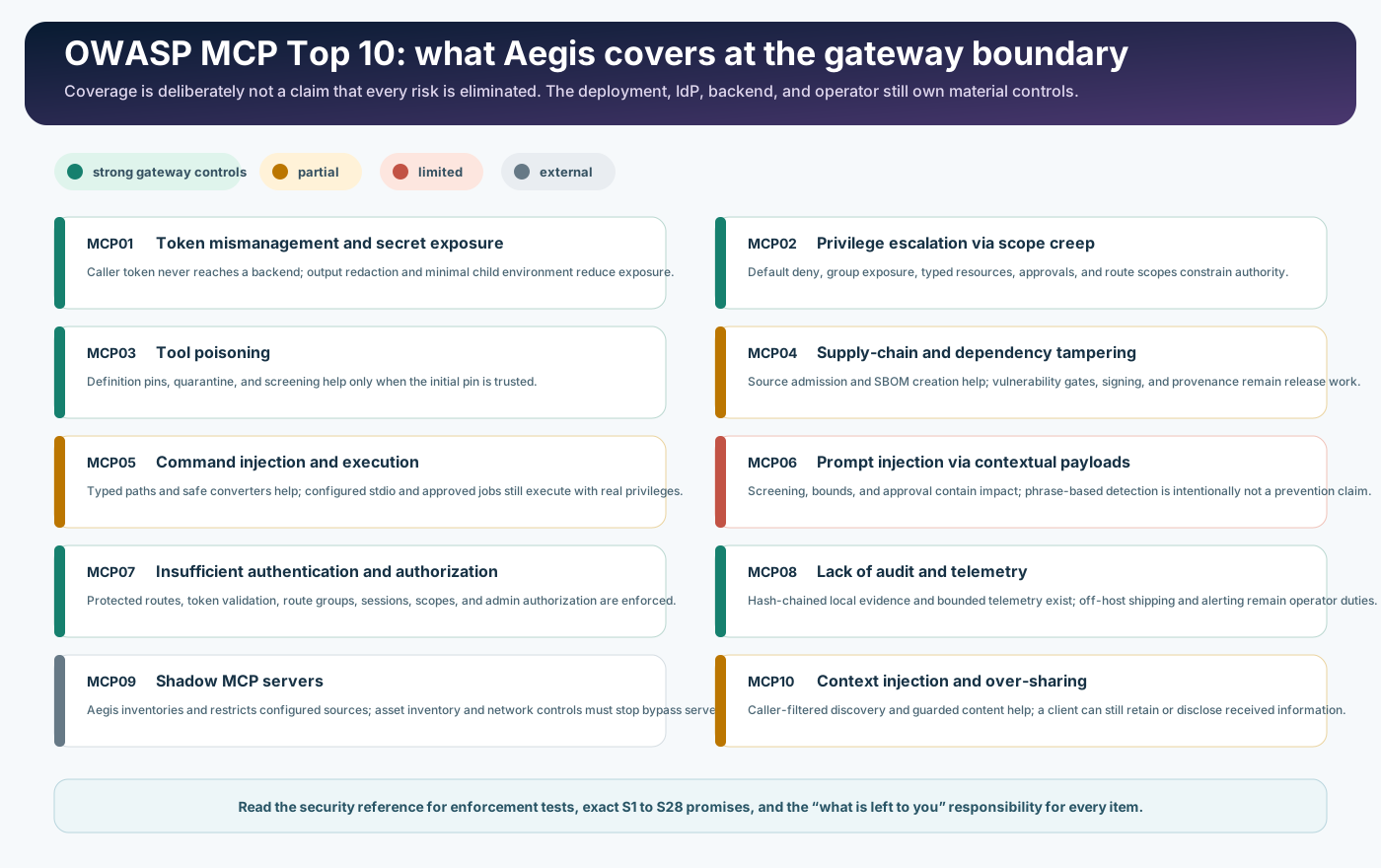
OWASP MCP TOP 10
PROMISES
Each property names the enforcing class and the test that must stay green. Breaking one is treated as a vulnerability. Highlights for reviewers:
actionScopes need exact verified JWT scopes before policy.serverCatalog decides at startup which servers may start; a break-glass order can only contain them.RECORDED EVIDENCE
The 2026-10-05 record reports a focused S1 to S31 selection run on JDK 17 with Maven Surefire: 227 selected tests, 0 failures. Tests added after that date are outside the 227 count.
A later hardening pass on 2026-11-07 ran the eight core modules as one build with every gate on: 408 tests, 0 failures, with SpotBugs and the FindSecBugs plugin, JaCoCo coverage, and the Apache RAT license check all green. The SpotBugs run reported 72 findings on its first pass; the real defects (constant-time digest comparison, a regex denial-of-service path, null guards, dead code) were fixed, and every remaining exclusion carries a written reason. CodeQL and an OSV dependency scan are committed as CI workflows but are not yet run from this host.
Build gates in the hardened profile: SpotBugs with FindSecBugs (static and security analysis), JaCoCo (coverage), Apache RAT (license headers), and the CI-side CodeQL and OSV scans. The CVE containment demo adds a runtime before-and-after proof against three real MCP server flaw classes.
Governance, SoD, egress, catalog, admin CSRF, JWT/scopes, Knox packaging boundary, token exchange unit tests, output bounds, hooks fail-closed.
Real-engine Keep runs, Keycloak token exchange, OpenBao secrets, and Postgres state have their own evidence files under docs/evidence/.
RESIDUAL RISK
Report vulnerabilities privately via a GitHub security advisory. Do not open a public issue for an unfixed vulnerability.
REFERENCE MAP